10 Easy Ways to Implement AI in Your Business (Without Blowing Up What Already Works)
· By Peter Lowe
Category: Automation
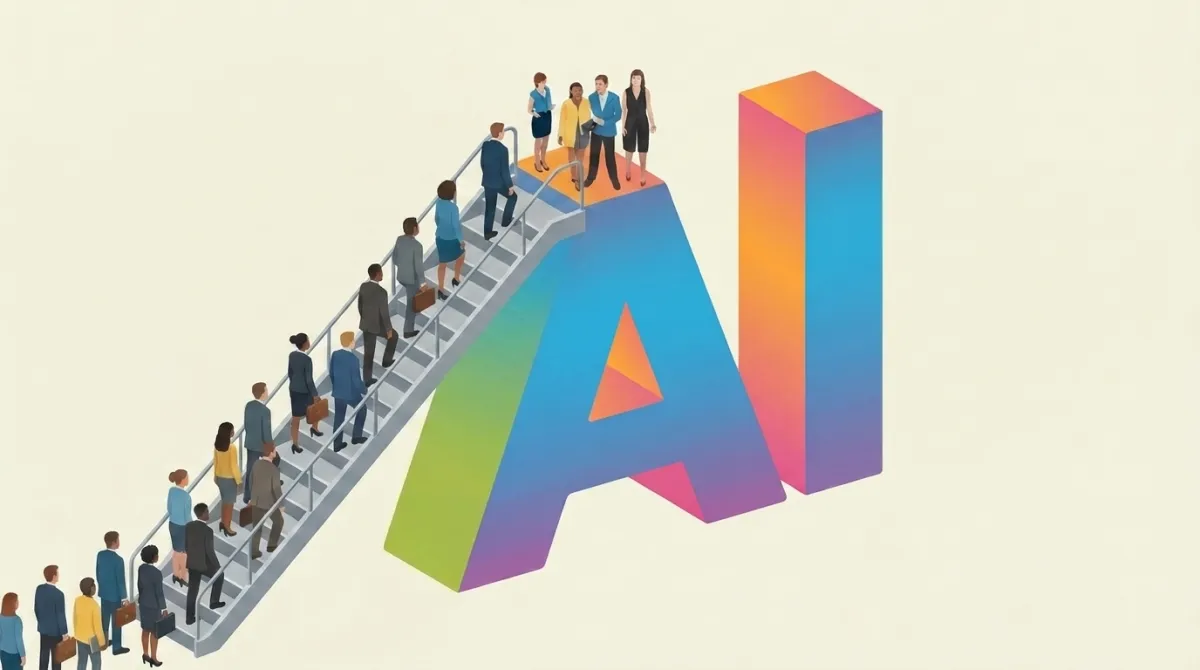
Most of the AI conversations I have with SME owners start the same way: "I know we should be doing something with AI, I just don't know where to begin." Fair enough. The headlines are loud, the hype is louder, and almost nobody is talking about the boring middle ground — the small, specific changes that actually save time and make money.
So here are ten of them. None of these require a data science team, a six-figure budget, or a twelve-month transformation programme. They're the places I'd point a marketing director, operations lead, or business owner who wants to get AI earning its keep in the next 30 days.
> **⚠️ A quick note on data privacy.** Before you upload any business or customer data to AI tools, always check the platform's data sharing and privacy settings. Many SMEs skip this step — it's a common mistake that can expose sensitive information. Look for options to disable data retention, training, and third-party sharing before you start.
## 1. Customer Service Automation
The obvious one, but still the most under-used. A well-configured AI chatbot can handle around 40% of routine customer enquiries on its own — opening hours, order status, basic troubleshooting, "where's my invoice" — and hand over to a human when it genuinely needs to.
The trick isn't buying a chatbot. It's writing the knowledge base behind it properly. Teams that treat this as a content project, not an IT project, see returns of 300%+ within a year. Those that bolt it on and walk away end up with an angry FAQ that frustrates customers.
**Start here:** Pull your last three months of support tickets (with data sharing and privacy settings implemented). Whatever question appears most often — that's your first automation. I did exactly this exercise with a board-level client recently and we found three question types accounted for over half their inbound volume. That's a workload halving sitting in plain sight.
## 2. Email Response Assistance
Not full automation. Assistance. Tools like Claude or a well-prompted GPT can draft replies in seconds, keep your tone consistent across the team, and free your people up for the conversations that actually need a human brain.
I use this daily. The draft isn't always right, but it gets me 80% of the way there and I edit the rest. For a team handling 50+ emails a day, that's hours back every week.
**Start here:** Pick one recurring email type — quote follow-ups, meeting confirmations, onboarding welcomes — and build a prompt template your whole team uses.
## 3. Content Creation and Optimisation
Blog posts, product descriptions, social captions, course materials, internal training docs. AI won't replace a good writer, but it will compress the production time by around 40% and take the pain out of the blank page.
The mistake I see most often is treating AI like a vending machine — prompt in, finished article out. It doesn't work like that. The good stuff comes from treating it as a collaborator: you bring the strategy, the insight, and the brand voice; it handles the heavy lifting of drafting and restructuring.
**Start here:** Take one piece of content you already have and ask AI to repurpose it into three new formats. LinkedIn post, email, short video script. I run a 15-article content calendar for one of my clients in the funeral services sector across five content pillars — the volume would be impossible without AI in the loop, but the strategy and the voice are still entirely human. That balance is the whole game.
## 4. Personalised Marketing Campaigns
This is where the real money is for most SMEs, and almost nobody does it properly. AI can analyse your customer data (with data sharing and privacy settings implemented) to segment your list, tailor subject lines, personalise web copy, and recommend products based on individual behaviour — at a scale that used to need an agency retainer.
You don't need a CDP and a machine learning team. You need clean data and a willingness to test.
**Start here:** Segment your next email campaign into three groups instead of sending one blast to everyone. Measure the difference.
## 5. Data Analysis and Predictive Insights
If you've got a spreadsheet with more than 1,000 rows and you're still trying to spot patterns by eye, you're leaving money on the table. AI can forecast demand, flag anomalies, spot seasonal trends, and turn messy data into something you can actually make decisions on.
This is the one SME owners dismiss as "not for us" — then watch a competitor dominate with better forecasting.
**Start here:** Upload your last 12 months of sales data (with data sharing and privacy settings implemented) to Claude or ChatGPT and ask it what patterns it sees. You'll be surprised.
> **A quick interruption.** Everything in points 1–5 is something we cover in the Smart AI Studio AI Essentials Workshop — a half-day, hands-on session for up to 12 people from your team, £147 per person. You leave with your first automation already built, not just a list of ideas. If "I haven't got time to figure this out myself" sounds familiar, [drop me a line](/contact).
## 6. Process Mapping and Automation
Most SMEs have processes that are part of their DNA and part of their headache. Invoicing, onboarding, stock control, quality checks. These run through multiple people, often across multiple systems, and nobody questions them until they break.
AI won't magically tidy your processes. But it will help you map them properly, spot where automation makes sense, and design the handoffs so people only touch the bits that actually need a human.
**Here's the thing most people miss: simply mapping your processes properly will reveal efficiencies and savings before you even add AI to the mix.** The act of documenting what actually happens — not what you think happens — almost always exposes redundant steps, unnecessary approvals, and bottlenecks that can be fixed immediately.
**Start here:** Pick one multi-step process that annoys your team every week. Map it out — actually draw it, boxes and arrows — and identify one handoff or approval that could be automated without risk.
## 7. Meeting Transcription and Action Extraction
Most meetings generate ideas that vanish the moment people leave the room. AI transcription tools don't just record what was said; they can pull out action items, assign owners, and flag follow-ups automatically.
The real value isn't the transcript. It's the accountability loop that gets created when every meeting produces a clear, assigned task list.
**Start here:** Run your next internal meeting through a transcription tool (with data sharing and privacy settings implemented). Review the action extraction against your own notes. You'll see where it saves time and where it misses nuance — both are useful to know.
## 8. Recruitment Screening
Not CV keyword matching — that's a recipe for bias. I mean the administrative slog of recruitment: scheduling interviews, answering candidate questions, tracking applications across multiple platforms.
AI can handle 80% of this, freeing up actual time to evaluate the human stuff that matters.
**Start here:** Audit your current recruitment process. How many hours per hire are spent on tasks that don't require judgement? That's your automation target.
## 9. Training and Onboarding Documentation
Every growing business struggles to get new people up to speed quickly without overwhelming them. AI can help you structure training materials, generate role-specific guides, and even create practice scenarios for new hires to work through.
The output still needs your expertise, your standards, and your culture. But it cuts the production time dramatically and lets you scale onboarding without scaling your management hours proportionally.
**Start here:** Document one common onboarding question that every new hire asks. Turn that into an AI-assisted guide, test it with your next hire, refine it. Repeat.
## 10. Proposal and Quote Generation
If your sales team is still writing proposals from scratch, you're burning expensive hours on repetitive work. AI can draft proposals from templates, pull in client-specific details (with data sharing and privacy settings implemented), and even suggest pricing tiers based on previous wins.
This isn't about replacing your salespeople. It's about letting them focus on the conversation and the relationship instead of wrestling with formatting.
**Start here:** Take your three most common proposal types. Build a template for each with AI-generated first drafts that your team reviews and personalises.
## The Pattern Behind All Ten
Notice what these have in common: none of them replace humans. They replace time. They remove the repetitive, low-judgement work that fills up days and prevents your people from doing the work that actually drives the business forward.
That's the core of a good AI strategy. Not the technology for its own sake, but the specific, measurable return you get from each deployment.
If you'd like help prioritising which of these makes sense for your business — or support building out the first one — [drop me a line](/contact) and we'll set up a quick call. No pitch, no audit required. Just practical advice on where to start.
## FAQ
### What is the easiest way to start using AI in a small business?
Start with a task that repeats weekly, has a clear output and does not touch sensitive data — drafting replies, summarising notes, or tidying up documents. It proves the value quickly without putting anything important at risk.
### How long before we see a return?
For a well-chosen first task, weeks rather than months. If you cannot see a difference within a month, the problem is usually the choice of task, not the technology.
### Do we need to replace our existing systems?
No. The examples that work best sit alongside what you already use. Replacing systems is a much larger decision and should never be a side effect of trying AI.
This article was written by Peter Lowe. The ideas and opinions are his own; AI was used to assist with drafting and editing.