Brand Voice in the Age of AI: How SMEs Stay Recognisable When Everyone Sounds the Same
· By Peter Lowe
Category: Content
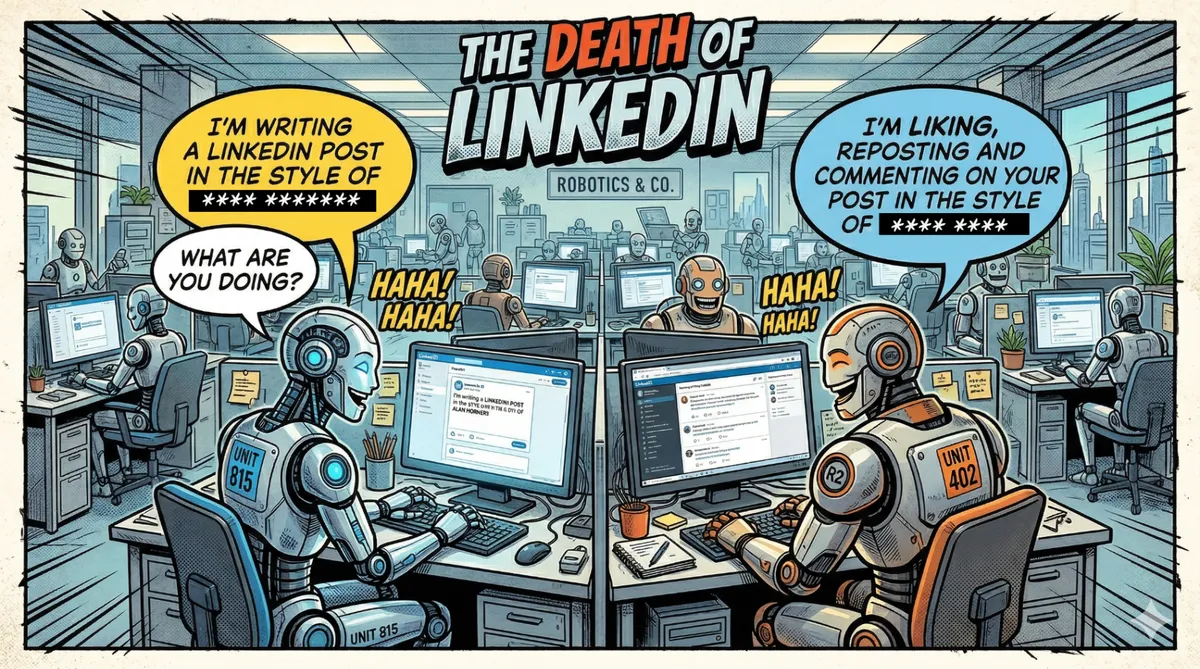
Scroll your LinkedIn feed for two minutes. Notice anything?
The posts are starting to blur together. Same opening hooks. Same em-dashes. Same "It's not X — it's Y" structures. Same tidy three-bullet payoffs. Different logos, identical voice.
This isn't a coincidence. It's what happens when thousands of businesses use the same three AI tools with the same default prompts and publish the output without editing. The tools didn't cause it. Lazy use of the tools caused it.
And here's the part that should worry any SME owner: if your content sounds like everyone else's, buyers stop reading it. They've been trained — by sheer volume — to skim past anything that pattern-matches to "AI wrote this."
The good news is the fix isn't complicated. It just requires you to be deliberate about three things.
## Why this matters more for SMEs
Big brands have things to fall back on when their content goes generic. Visual identity. Ad budgets. Decades of recognition. Most buyers already know who they are before they read a single word.
SMEs don't have that cushion. The thing that made someone choose you in the first place was probably a point of view, a way of explaining things, a feeling that you understood their situation better than the larger competitor down the road. That's voice. And voice is exactly what gets stripped out when you copy-paste from ChatGPT and hit publish.
If you lose your voice, you lose the only thing buyers were using to tell you apart.
## Layer one: a one-page brand voice document
Most SMEs don't have anything written down about how they sound. Voice lives in the founder's head, and gets approximated by whoever happens to be writing that day.
That worked when one person wrote everything. It does not work when AI is in the mix, because AI defaults to a kind of polite, mid-Atlantic, slightly breathless style that has nothing to do with you.
Here's what a usable one-pager actually contains:
**Three voice traits.** Not ten. Three. Things like direct, plain-spoken, quietly confident. Each one with a sentence explaining what you mean and a short example.
**Words and phrases you use.** The actual language. If you say "businesses" not "organisations", write that down. If you never use "leverage" as a verb, write that down too.
**Words and phrases you don't use.** This is the part most guides skip and it's the most useful. "Unlock". "Game-changer". "In today's fast-paced world". List the words that make you cringe and the AI will avoid them.
**A before-and-after example.** One paragraph in generic AI-speak, one paragraph in your voice. Nothing teaches the pattern faster than seeing the contrast.
That's it. One page. If it runs longer, nobody will read it, including you.
## Layer two: prompts that load the voice, not blank-slate requests
The single biggest reason AI content sounds generic is that people type "write me a LinkedIn post about X" and accept whatever comes back.
A blank-slate prompt produces blank-slate content. The fix is to give the AI your voice document as context, every time, before you ask it to write anything.
In practice that looks like this:
"I'm going to share a one-page brand voice guide. Read it carefully. From this point on, every piece of content you write for me must follow these rules. Confirm you've read it before I give you the topic."
Then paste the one-pager. Then ask for the post.
The output will be noticeably more like you. Not perfect — you'll still need a human pass — but it starts in the right place instead of needing a full rewrite.
If you use ChatGPT Projects, Claude Projects, or a custom GPT, you can load the voice document once and it stays loaded. That's worth the ten minutes it takes to set up.
## Layer three: a non-negotiable human edit
This is the layer most teams skip. They shouldn't.
AI is excellent at producing a draft. It is not good at producing something that sounds unmistakably like a specific person. The gap between the two is closed by a human who knows what the brand sounds like and is willing to spend five minutes making changes.
A useful editing checklist:
**Read it out loud.** If you wouldn't say it that way, change it.
**Hunt for AI tells** — "delve", "navigate", "in the realm of", excessive em-dashes, three-item lists where two would do.
**Cut the polite throat-clearing.** AI loves opening with "In today's competitive landscape…". Delete it.
**Add one specific thing.** A real example, a real number, a real client situation. Specifics are the fastest way to make content sound human.
**Read it once more for rhythm.** Vary sentence length. Short sentences land. Long ones build.
Five minutes per post. That's the price of sounding like yourself at scale.
## What to avoid
A few traps worth naming:
**Letting different people use different prompts.** If three team members each have their own way of prompting, you'll get three different voices. Centralise the prompt and the voice document.
**Treating AI output as final copy.** It isn't. It's a draft. Any team member who hits publish without editing should be quietly retrained.
**Over-polishing until everything sounds like a press release.** The goal isn't perfection. It's recognisability.
## The practical takeaway
The businesses winning with AI content aren't the ones producing the most. They're the ones still sounding like themselves at volume.
That comes down to three things you can put in place this week: a one-page voice document, a standard prompt that loads it, and a five-minute human edit before anything goes out.
None of it is technically difficult. All of it requires the discipline to slow down for ten minutes before speeding up.
If you'd like a copy of the one-page brand voice template Smart AI Studio uses with clients, drop me a message on LinkedIn and I'll send it over.
*Peter Lowe is the founder of Smart AI Studio, helping SMEs integrate AI into their marketing and operations without losing what makes them distinctive.*
## FAQ
### Why does AI-written content all sound the same?
Because the models default to the average of everything they have read. Without direction they produce fluent, agreeable, forgettable prose. The sameness is a briefing problem, not a capability limit.
### What is a brand voice document?
One page describing how your business sounds: the words you use and avoid, sentence length, the level of formality, and two or three examples of writing you would be happy to publish. It is what you paste in alongside every prompt.
### How much human editing is needed?
Usually five minutes: cut the filler opening, replace generic claims with something only your business could say, and check the facts. That short pass is what keeps the writing recognisably yours.
This article was written by Peter Lowe. The ideas and opinions are his own; AI was used to assist with drafting and editing.