Buying AI from a Supplier: 8 Questions to Ask Before You Sign Anything
· By Peter Lowe
Category: Governance
There is a comfortable assumption behind most software purchases: if we buy it from a reputable vendor, the legal responsibility sits with them. They built it. We’re just using it.
For AI, that assumption is wrong — and the gap between what business owners assume and what UK and EU law actually says is one of the most common ways businesses end up exposed.
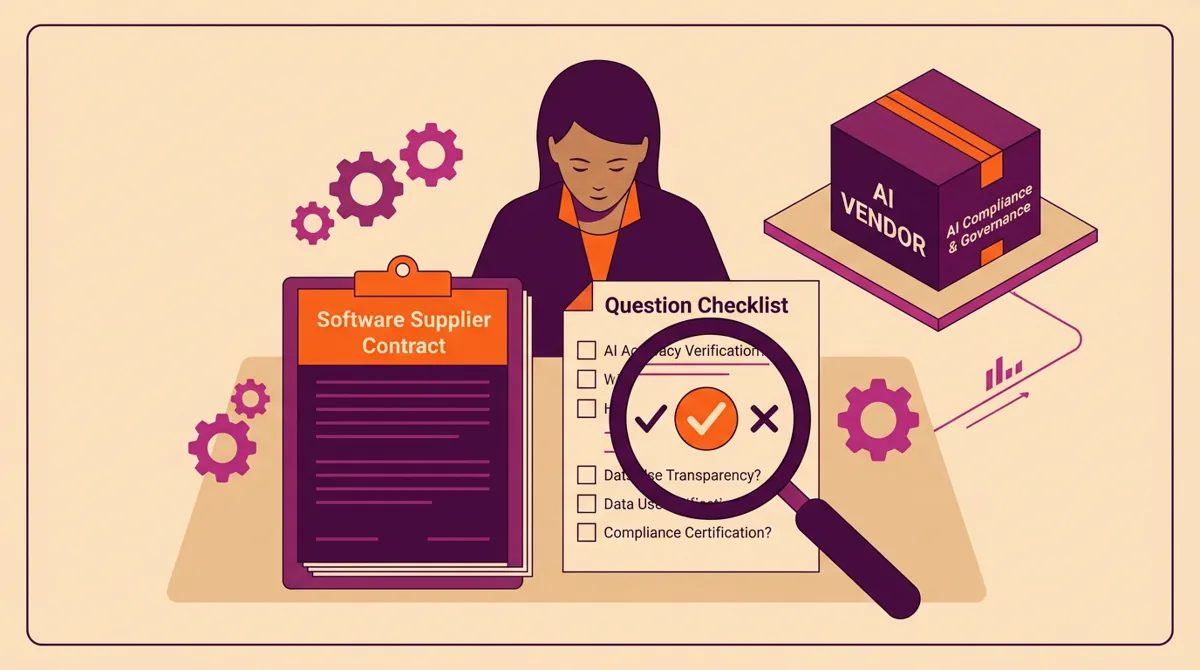
This piece covers the eight questions to ask before signing or renewing any AI tool: what each one means, what a good answer sounds like, what a red flag sounds like, and what to do if the supplier can’t or won’t answer. It’s the same supplier check we run with clients, in a form a procurement lead, MD or FD can use directly.
If you haven’t read the [pillar guide on AI compliance](/insights/ai-compliance-governance-uk-business-owners/) yet, that sets the wider context. This is the deep dive on getting your suppliers right.
## You are accountable, not them
Under UK data protection law, the business deploying an AI tool — you — is the one accountable to the regulator. The supplier is usually the “processor”; you are the “controller.” If their tool makes a biased decision about a job applicant, the tribunal claim lands on your desk. If it handles personal data unlawfully, the ICO comes to you.
The OpenAI fine made this concrete. In December 2024 Italy’s data regulator fined OpenAI €15 million, finding it had collected personal data to train ChatGPT without an adequate legal basis, hadn’t been clear with users about how their data was used, and lacked proper age checks. (OpenAI is appealing.) The fine landed on OpenAI because it trained the model.
The read-across for everyone else is the part that gets less attention. Every business that had wired ChatGPT into its workflows over the previous two years was, at the same time, feeding customer data into a system a regulator later found had been operating without an adequate legal basis. None of them had asked the question. The supplier was reputable. The tool was popular. “Everyone’s using it” felt like cover.
It isn’t, and never has been. The question you ask before you sign is the one that protects you when something goes wrong upstream.
## The eight questions
Put these to any AI supplier — new or existing — in writing. Verbal reassurance doesn’t survive a regulatory investigation. Get the answers in the contract, or a documented annex to it.
### What does this tool actually do with our data?
The honest version: once our data goes in, where does it go, who sees it, and is it used to train your wider model?
**Good answer.** Specific — what data is used, what for, where it’s processed, whether your data is kept separate from other customers’, and a clear line on whether your inputs train the underlying model.
**Red flag.** Vague reassurance: “your data is secure,” “we take privacy seriously.” That’s policy theatre. Press for specifics.
### Where is the data stored — UK, EU or elsewhere?
This is a UK data protection question. Personal data leaving the UK or EU triggers extra legal steps — a UK-approved data transfer agreement, or reliance on a UK “adequacy” decision for that country. Storing data in the US, India or anywhere outside the UK and EU isn’t automatically a problem, but it has to be properly documented.
**Good answer.** Names the country and the legal mechanism that makes the transfer lawful.
**Red flag.** “We have data centres around the world,” with no specifics — or a defensive tone when you ask.
### Has it been independently tested for bias or unfair outcomes?
This matters most for AI that affects decisions about people — recruitment, credit, service triage, performance. If the answer is no, the supplier is asking you to take their word that the tool doesn’t discriminate. Under the Equality Act 2010 that isn’t enough, and the EU AI Act will add formal bias-testing duties for high-risk tools.
**Good answer.** Points to specific testing, independent audits, fairness documentation or third-party certification. Some suppliers now publish “model cards” that set this out.
**Red flag.** “We test it internally.” Necessary, but not sufficient for a genuinely high-risk tool — you want external validation.
### What security certifications does it hold?
Look for ISO 27001 (information security), SOC 2 (a security-controls audit), Cyber Essentials Plus (the UK government-backed scheme), and increasingly ISO 42001 (the AI management standard).
**Good answer.** Current certificates — not expired ones — and a willingness to share the latest audit summary.
**Red flag.** None of these. Tolerable for a low-risk tool; not for anything handling personal data at scale.
### Can we audit how the tool makes its decisions?
If a customer or employee challenges a decision the tool was part of — and they have a legal right to — you need to be able to explain how it reached its conclusion. “The computer said no” is not a defence the ICO accepts.
**Good answer.** Gives you visibility: explainability documentation, decision logs, the ability to investigate individual outcomes.
**Red flag.** “The model is proprietary, we can’t share how it works.” That may protect their IP, but it leaves you unable to meet your obligations. Push for a contractual commitment that they’ll help you answer challenges, even if the model itself stays a black box.
### What happens if it makes a mistake — who’s liable?
Read the contract. Most AI vendor contracts carry aggressive liability limits — capped at a few months’ fees, excluding consequential losses, sometimes excluding liability for AI outputs altogether.
**Good answer.** A clear liability position you can live with, with carve-outs for data protection breaches and indemnities for IP infringement.
**Red flag.** A supplier who won’t negotiate liability, or who buries the exclusions in click-through terms. For high-risk AI, this is the clause that matters most when something goes wrong.
### Will you tell us if you make significant changes to how the AI works?
AI models aren’t static. Vendors update them constantly, and a model tested for bias six months ago can behave differently after an update. A tool that was compliant at the start of your contract may not be at the end.
**Good answer.** A commitment to tell you about material changes in advance, with the right to pause or opt out if a change affects your compliance position.
**Red flag.** Silence on this — or terms that let the supplier change functionality without notice.
### Do you have a written data processing agreement we can sign?
This isn’t a preference; it’s a legal requirement under UK GDPR if the supplier handles personal data for you. Without a Data Processing Agreement (DPA), you’re technically in breach the moment you send them a single piece of personal data.
**Good answer.** “Yes, here it is” — covering the standard things: purpose, duration, types of data, security, sub-processors, breach notification.
**Red flag.** A supplier who doesn’t know what a DPA is, or tries to fob you off with generic terms of service.
## The contract clauses that matter
Beyond the eight questions, three clauses are worth pushing for in any AI contract. If a supplier won’t agree to them, that tells you something.
**Change notification —** they tell you before material changes to how the AI works, with enough lead time to assess the implications.
**Audit rights —** for high-risk tools, a contractual right to audit their compliance, including how they handle your data.
**Liability for regulatory action —** if a regulator fines you because of something their tool did, the contract should address how that risk is shared. You’ll rarely get full indemnity, but you should get something.
## What to do if you’ve already signed
Most businesses aren’t at the start of a procurement — they’ve already bought the tools. So run the eight questions against every AI tool already in use, the high-risk ones first. Many answers are already on the supplier’s website or in their documentation. Where they aren’t, write and ask — how readily they respond is itself useful intelligence. Where the answers are poor and the tool is high-risk, plan to replace it at the next renewal, and record the gap in your register in the meantime so you have a defensible position if asked.
This isn’t about ripping out tools that work. It’s about knowing what you’ve got and being able to show you asked the right questions.
## Where to start this week
Pull the contract for your highest-risk AI tool — usually the recruitment platform, the credit tool, or the customer-service AI. Run the eight questions against it. Write down which ones the contract or supplier documentation answers and which it doesn’t. For the gaps, draft an email to your account manager asking for written answers. The speed and quality of the reply will tell you more about your real exposure than any audit.
## Where a supplier’s answers fall short
When the answers aren’t good enough and the tool matters, that’s a point for proper advice — but the adviser you want helps you fix the relationship or find a compliant alternative, not simply condemn the tool. A good one will still tell you to walk away when the risk is real and the supplier won’t move. Most of the time, though, the useful outcome is a better contract, not a torn-up one.
If you’d rather run this with someone — including drafting the supplier letters and reviewing the contracts against current [UK GDPR](https://ico.org.uk/for-organisations/uk-gdpr-guidance-and-resources/) and EU AI Act standards — that’s the kind of [supplier review](/ai-consultancy/) we run at Smart AI Studio. It’s led by an AI governance expert, so timing depends on their availability. [Book a call with Peter](/contact/) and we’ll go through your top three to five AI suppliers and tell you honestly what your contract risk looks like.
Buying AI from a supplier is buying a relationship, not a product. Get the questions right at the start and it works for you. Skip them and they surface later anyway — usually at a worse moment.
## Frequently asked questions
### What is AI supplier due diligence?
AI supplier due diligence is the set of questions you ask before buying an AI tool — covering what data it uses, where that data goes, who is accountable, and what happens when it gets something wrong. It turns a vague product pitch into a relationship you can actually govern.
### What should I ask an AI supplier before signing?
Cover data location and retention, sub-processors, training-data use, human oversight, accuracy and redress, security certifications, exit terms, and liability. If a supplier cannot answer clearly in writing, treat that as a finding in itself.
### Who is liable if a third-party AI tool breaches data protection?
As the organisation using the tool you usually remain the data controller, so liability rarely disappears just because a supplier caused the problem. That is exactly why supplier due diligence — and a contract that reflects it — matters before you sign.
*Smart AI Studio works with UK business owners and leadership teams on practical AI adoption, including compliance, governance and risk. This article reflects the regulatory position as of July 2026 and is general guidance, not legal advice. AI regulation and data protection rules are moving quickly, so check the current position before acting. For specific compliance questions, consult a qualified solicitor or data protection specialist.*
This article was written by Peter Lowe. The ideas and opinions are his own; AI was used to assist with drafting and editing.