Most AI Problems Are Really Business Problems
· By Peter Lowe
Category: Strategy
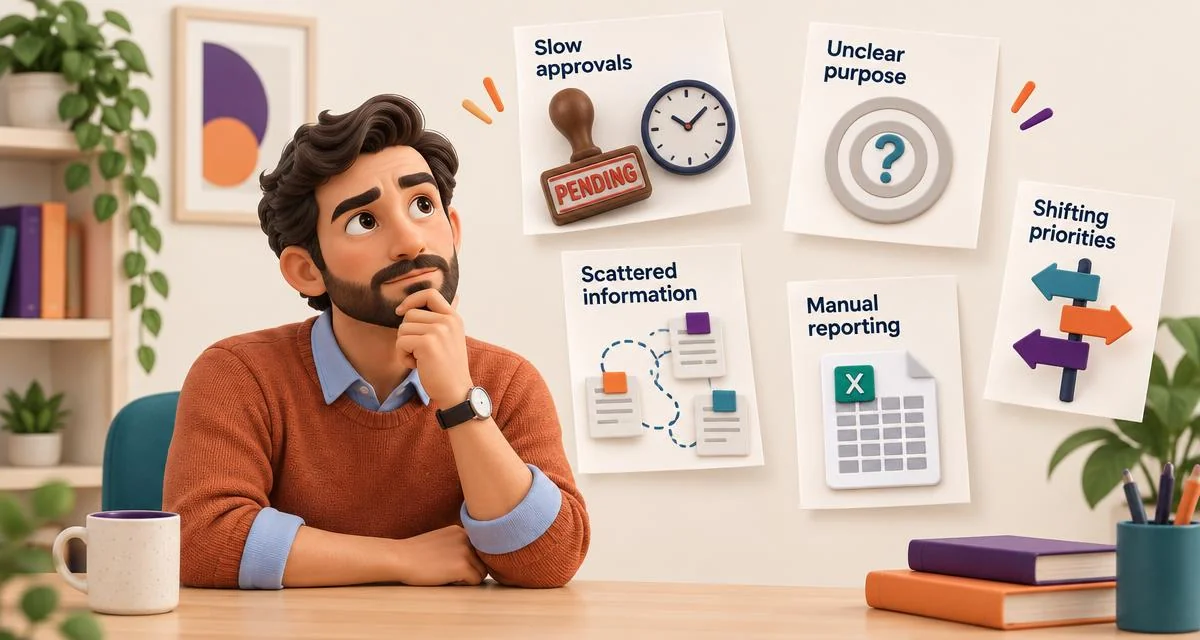
## Does this sound familiar
An idea is ready to move forward, but nobody knows who has the final
say.
A piece of content is produced because it was on the schedule, without a
clear view of what it should achieve.
Someone spends Friday afternoon collecting figures from three systems
for a report that arrives too late to influence the week.
A team starts Monday with a plan. By lunchtime, urgent requests have
pushed it aside.
You could be working in marketing, operations or finance. The details
change, but the frustration is familiar: plenty of activity, too much
chasing, and work that takes longer than it should.
Now add AI.
You can generate the first draft faster. Summarise the information.
Produce more options. But the approval still takes a week, the figures
still disagree, and nobody has decided which request matters most.
The technology has improved one task. The business problem remains.
## Look at the problem underneath the AI complaint
"The AI output isn't useful" may mean the brief never explained the
audience, purpose or standard required.
"The team isn't using it" may mean nobody has shown how it fits into
their actual work, or given them time to practise.
"It hasn't saved us much time" may mean the task it speeds up was never
the main source of delay.
These are possibilities to investigate, rather than reasons to excuse a
poor tool. AI can also produce errors, miss context or be unsuitable for
the task.
The point is to diagnose what is happening before buying another
subscription or asking everyone to write better prompts.
A useful question is:
**If we took AI out of this process tomorrow, would the same problem still exist?**
If the answer is yes, you have a business issue to address alongside
your AI experiment.
## The same friction appears across departments
In [AI in marketing isn't about tools — it's about throughput](/insights/ai-in-marketing-isnt-about-tools-its-about-throughput/),
I explored how delays and fragmented workflows affect the journey from
an idea to a marketing outcome.
That principle applies across the business. To see it, look at what
people are waiting for, searching for and doing again.
### Approval loops
In marketing, a campaign can pass between reviewers with conflicting
preferences. In operations, a routine decision can sit with a manager
whose inbox is already full. In finance, an invoice can wait while
people debate who should authorise it.
AI may prepare the information for a decision. The business still needs
to define who decides, what they check and when an issue needs
escalating.
### Work without a clear purpose
A polished presentation, detailed report or new dashboard can look
productive. But what decision will it support? Who needs it? What will
they do differently?
AI makes it easier to create these outputs. That makes a clear purpose
more valuable.
Before producing anything, agree what it needs to achieve and what a
useful result looks like.
### Information scattered across systems
A customer detail sits in the CRM. A revised requirement is in an email.
The latest costing is in a spreadsheet that only one person knows about.
Connecting an AI tool to those sources does not settle which information
is current or authoritative.
Start by identifying the information the task needs, where it lives and
who maintains it. You can do that for one process without rebuilding
your entire data infrastructure.
### Manual and retrospective reporting
Consider a weekly operations report assembled by copying figures between
spreadsheets.
An AI-generated summary might reduce the writing time. But if most of
the effort goes into collecting and checking the figures, the larger
opportunity is earlier in the process.
Ask which decisions the report supports, when the information is needed
and which parts of collection could use a reliable integration or
standard automation.
### Constantly changing priorities
If every request becomes urgent, a faster drafting tool may simply help
the team start more work.
Leaders need to make trade-offs: what matters this week, what can wait,
and what gets paused when a new priority arrives.
AI can help organise requests and compare options. Someone still needs
to make and communicate the decision.
## Build a plan around one recurring problem
You do not need to solve every process issue before using AI. Small
experiments can help you understand the work and test improvements.
Start with a problem that happens regularly and has a visible cost.
### 1. Describe it in business terms
"Improve finance with AI" is too broad.
"Our finance team spends several hours each week chasing missing invoice
information" gives you something to investigate.
Name the work, the people affected and the consequence.
### 2. Follow a real example
Take a recent invoice, customer enquiry or content request. Trace what
happened from arrival to completion.
Speak to the people doing the work. Where did it wait? What was missing?
What had to be corrected? Which workaround kept things moving?
Document the process people actually use.
### 3. Fix the source of the delay
Perhaps requests arrive without essential details. Perhaps three people
review work without agreed responsibilities. Perhaps staff keep
re-entering information that already exists elsewhere.
Improve that part first. A standard form, clearer decision rights or a
system connection may be enough.
AI may help analyse the examples or draft a better checklist. Its role
should follow the problem you have identified.
### 4. Test a specific use for AI
Once the work is clearer, choose a bounded task: drafting a response
from approved information, summarising a handover or flagging
potentially missing details for review.
Agree what information it can use, who checks the result and what
happens when it gets something wrong.
### 5. Measure the complete result
Measure more than the time spent on the AI-assisted task.
Did the work reach completion sooner? Did people spend less time
chasing? Was there less rework? Did quality hold up?
Give someone responsibility for reviewing the results and deciding
whether to improve, expand or stop the test.
## What is your plan to fix the problem
A useful starting plan can fit on one page:
- **Problem:** What keeps going wrong?
- **Impact:** What does it cost in time, rework, delays or missed
opportunities?
- **Owner:** Who is responsible for improving it?
- **First change:** What will you change in the next two weeks?
- **AI test:** Where could AI make that improved process more effective?
- **Measure:** How will you know the change has worked?
That gives your team a concrete next step.
At Smart AI Studio, we start with [the work your business needs to improve](/services/process-mapping/): the chasing, repeated effort and unclear handoffs that consume
time and capacity. Then we work out where AI can make a useful
contribution.
**Which recurring problem will you fix first, who will own it, and what will be different a month from now?** If you would like to work through that question together, [get in touch](/contact/).
## FAQs
### Why do AI projects fail to deliver business value?
AI projects can stall when the underlying work has unclear objectives, slow approvals, inconsistent information or no agreed owner. Check the process and the tool separately before deciding what to change.
### Should we fix our processes before trying AI?
You do not have to fix everything first. Start with one recurring problem, improve the part that causes the most delay, then test a specific AI use within that clearer process.
### How do we tell whether AI has actually helped?
Measure the complete result: time to completion, time spent chasing, rework and quality. Saving minutes on a draft does not help much if the work still waits days for a decision.
This article was written by Peter Lowe. The ideas and opinions are his own; AI was used to assist with drafting and editing.