AI Champions: The People Who Make Adoption Work
· By Peter Lowe
Category: Governance
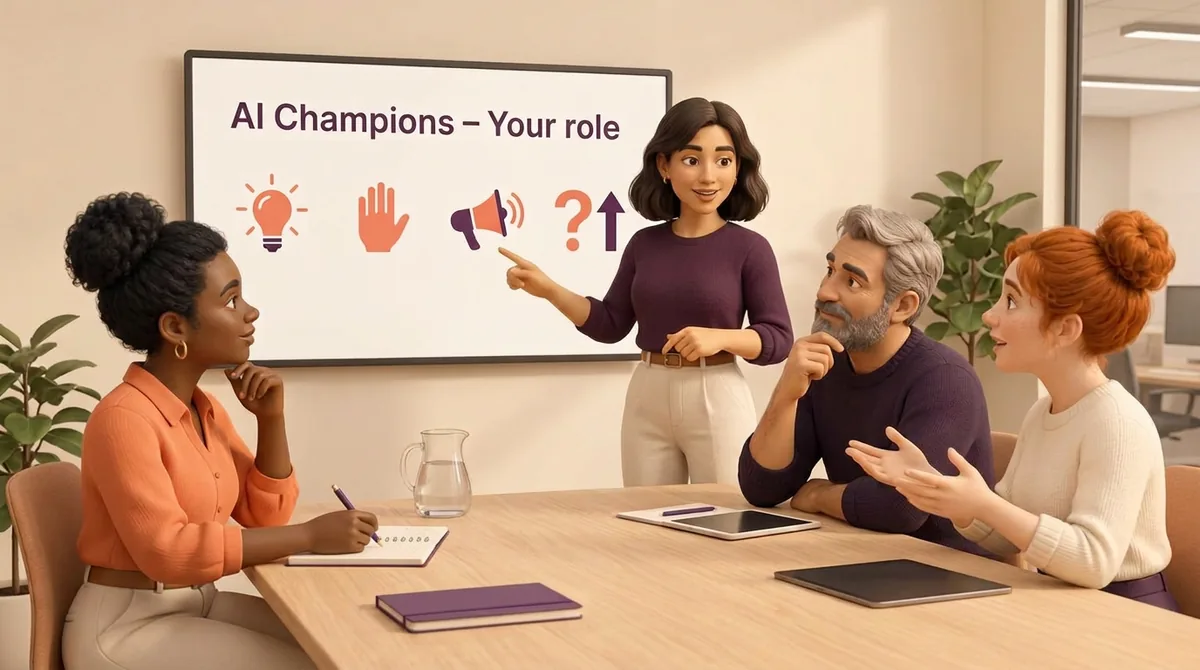
“You've all got access to Copilot now.”It sounds like an AI rollout. In practice, it leaves the harder questions unanswered. What should people use it for? Which information can they share? How do they check the output? Who helps when the first attempt is disappointing?AI Champions can help answer those questions in the context of real work. They are a colleague who listens, shows useful examples, helps others build confidence and brings problems back to the people who can resolve them. They do not need to know every tool or write the business's AI strategy.In shortChoose champions who understand the work and can help colleagues learn, not simply the most enthusiastic tool users.Give them a clear brief, training, protected time and a route for questions they cannot resolve.Ask them to identify process problems and share tested examples, rather than collect prompts for their own sake.Keep policy approval, security decisions and investment with accountable leaders and specialists.Measure whether colleagues can use AI appropriately and whether work improves, not just how many demonstrations were held.Why a champion role can helpSkills England's employer guide, based on workshops, case studies and a survey, found that many employees learn AI through trial and error, peer support or features already inside workplace software. It recommends hands-on learning tied to real tasks, with repeated practice and feedback. Its supporting research says local coaching and mentoring can help people who lack confidence or digital experience. Sources: Skills England employer guide and research evidence.A workshop can teach the basics; a champion helps apply them to the customer enquiry, report or planning process in front of someone.Champions share approved practice, then tell leaders where guidance is unclear or a process needs attention. OpenAI Academy likewise distinguishes organisation-level leaders from people close to team workflows who support learning and surface feedback. Source: OpenAI Academy.What should an AI Champion actually do?A useful brief could cover four activities:Listen for friction. Ask colleagues which tasks are repetitive, slow or inconsistent. Find out what happens before suggesting a tool. If the input is missing or nobody owns the decision, the process needs attention first.Show approved, repeatable examples. Demonstrate one task using the business's permitted tools and information. Explain the input, the steps, what a good result looks like and the checks required. Save an example colleagues can adapt.Help colleagues practise. Offer a short session or time for questions. Include people who are sceptical or less confident. A champion should make it easy to say “I don't understand this” or “the output was wrong”.Feed back what they learn. Bring patterns to the process owner or AI Council: repeated questions, useful ideas, risks, poor outputs and training needs. The champion can recommend a working-group investigation; leaders decide what can be approved or scaled.The point is to help the team perform its work well.How do you choose the right person?Look for credibility with colleagues, curiosity, patience and knowledge of the team's work. A skilled AI user who cannot explain their approach or listen to objections may struggle in this role. Conversely, someone who is learning but asks good questions may be excellent.Invite volunteers from operational and management roles. Start where someone is interested and a process needs attention; expand when the support model works.Skills England's case studies describe pathways from basic AI literacy to champion roles, alongside peer learning and leadership participation. These are examples of delivery models, not evidence that every SME needs a large champion network. Source: Skills England supporting case studies.Give the role time and boundariesAgree a pilot period and protected time for learning, helping colleagues and reporting back. Adjust their normal workload.Provide training in approved tools, data handling, checking outputs and the limits of the role. Give the champion a named sponsor and a route to IT, security, data protection or HR when a question needs specialist judgement. Connect champions to one another if there are several, so they can share lessons.The boundaries should be equally clear. Champions do not approve new tools, decide whether personal data may be processed, own another team's performance or provide unlimited technical support. The AI policy and accountable leaders provide those decisions. Champions help colleagues apply approved practice and flag what needs review.A small example in practiceImagine a 40-person business where an operations coordinator becomes the first champion. The team spends hours each week compiling status reports from scattered notes. The coordinator starts by mapping where information comes from and which parts are checked by a manager.They show colleagues how an approved AI tool can help structure a first draft from permitted material, with a checklist for dates, figures and missing actions. When the trial reveals that source notes are inconsistent, they take that finding to the operations lead. The team standardises the notes before extending the test.The champion has helped people learn and surfaced a process problem. The manager still owns the report and decides whether the new method becomes routine. This is an illustrative example, not a client case study.How do you know whether it is working?After a short pilot, ask three questions. Can more colleagues describe an appropriate use and the checks it needs? Have the champion's examples been reused successfully? Did an identified process improve in quality, turnaround or rework?Watch for overload, unclear escalation and usage statistics that conceal poor results. Leaders should address those problems.This week's action: Write a five-line champion brief covering purpose, activities, time, escalation contact and one process to explore. Discuss it with a potential champion and their manager before assigning the role.Explore the governance seriesAI governance for SMEsAI CouncilAI policyAI working groups90-day governance review
FAQs
What is an AI Champion in a business?
An AI Champion is a colleague who helps a team learn approved AI practices, identify useful opportunities and share feedback with leaders. Their focus is the team's work and confidence, rather than being the organisation's sole technical expert.
Does an AI Champion need technical skills?
They need enough skill to use and evaluate approved tools responsibly, plus support to keep learning. Understanding the work, communicating clearly and knowing when to ask a specialist are often more valuable than advanced technical knowledge.
How many AI Champions does an SME need?
There is no universal ratio. One supported person in a willing team can test the approach. Add others when different teams have distinct processes and the first champion has a workable brief and support.
How much time should an AI Champion spend on the role?
Agree time based on the number of colleagues, the work and the pilot's aims. Put it in the brief and adjust normal workload accordingly. An informal title with no allocated time is unlikely to deliver consistent support.
What is the difference between an AI Champion and an AI Council member?
A champion helps colleagues use approved practices and reports what they learn. The council or accountable leaders set direction, approve significant uses and allocate resources. A person may contribute to both, but the decision rights should be explicit.
This article was written by Peter Lowe. The ideas and opinions are his own; AI was used to assist with drafting and editing.