Why Your AI Needs a Human in Charge (And What "Meaningful Oversight" Actually Looks Like)
· By Peter Lowe
Category: Governance
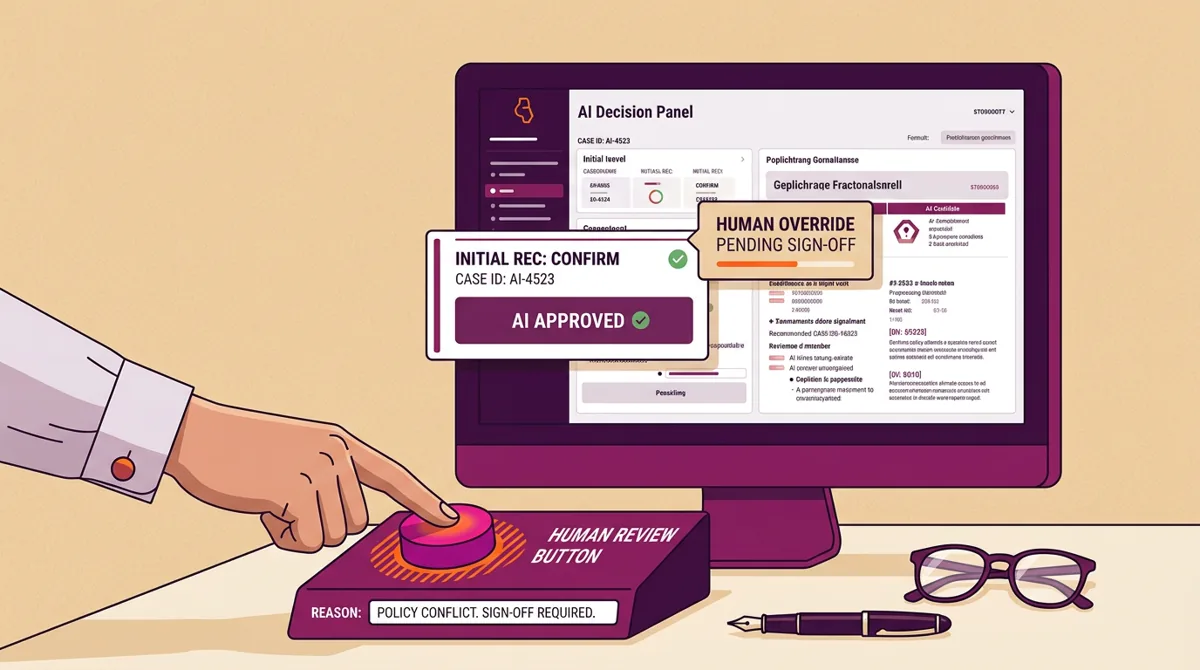
The conversation usually goes like this.
> *“Yes, of course there’s a human reviewing the AI’s decisions.”* > > *“Good. How often do they overturn the AI’s recommendation?”* > > *“…I’m not sure.”* > > *“How long do they spend on each one?”* > > *“It varies. They’ve got a lot to get through.”* > > *“Has anyone ever actually overturned one?”* > > *“…probably.”*
That conversation happens in UK businesses every week. It’s the moment an owner realises the human-in-the-loop process they thought was protecting them is, in practice, a rubber stamp. And the regulator has noticed: when the ICO examined automated decision-making in recruitment in early 2026, it found many employers believed their tools were merely “supporting” human decisions when, in practice, the tool was making the decision and no meaningful human review was happening.
This piece is about what genuine human oversight looks like, why “automation bias” is the failure mode to plan for, and what your board should do about it. As the [pillar guide](/insights/ai-compliance-governance-uk-business-owners/) sets out, this is the fourth of five priorities — and usually the one that needs the deepest change in how people actually work, not just what the policy says.
## What the law actually requires
Here’s the part that surprises people: UK law recently got more permissive about automated decisions, not less.
Until February 2026, UK data protection law treated solely automated decisions with legal or significant effects on people as broadly off-limits, allowed only in narrow circumstances. The Data (Use and Access) Act 2025 changed that. Since 5 February 2026, those decisions are permitted more widely — provided you put safeguards in place. (Decisions involving special-category data, such as health or ethnicity, stay under the stricter old rules.)
So the door is more open than it was. The catch is the safeguards. Where a significant decision about someone is made solely by an automated system, that person has the right to be told it was automated, to make their case, to get a human to review it, and to challenge the outcome. Those safeguards are now the main thing standing between an automated decision and a harmed customer or a wrongly rejected candidate — which is exactly why whether your human review is genuine matters more under the new regime, not less. The old rules mostly kept you out. The new ones let you in, on condition the safeguards are real.
The pivotal question is what counts as “meaningful human involvement” — because if a human is genuinely involved, the decision isn’t “solely automated” and the safeguards regime doesn’t bite. That line isn’t yet fixed in law: the Act lets the government define it later, and so far it hasn’t. In the meantime, the ICO’s draft guidance, published in March 2026 and consulted on through the spring, is the clearest steer, with a formal statutory code on AI and automated decisions expected later in
2026. So treat what follows as the ICO’s stated expectations — firming up rather than final.
On what does and doesn’t count, the ICO has been consistent. Human involvement has to be active, not a token gesture. The reviewer has to be able to influence the decision before it takes effect, and have the authority, the information and the competence to change it. Someone who nominally sits in the chain but only endorses whatever the system produces doesn’t make the decision “human” — the ICO treats that as no meaningful involvement at all. And the review has to happen for each decision, not as the occasional spot check.
The read-across is blunt. A reviewer who sees the AI’s output but not the data behind it, or who has a queue of two hundred cases to clear by the end of the day, or who has no real authority to say no, is not providing oversight. They’re providing cover.
If you have EU customers, the EU AI Act goes further for high-risk systems: the system has to be built so a human can step in effectively, and the people doing the oversight have to be trained, competent and given the time. Those duties are part of the high-risk regime now due to apply from December 2027.
## Automation bias: the failure mode to plan for
The honest reason most human-in-the-loop processes fail isn’t a lack of will. It’s a documented tendency called automation bias.
Automation bias is what happens when people start trusting the system’s output over their own judgement. The AI has been right hundreds of times. It looks confident. It produces a clean score. The reviewer is busy and the queue is long. So they click approve — not because they’ve assessed the case, but because the machine said so.
This isn’t a failing of individual staff. It’s the predictable result of asking people to oversee AI without the time, information or authority to do anything useful with the role. Design against it, or you’ll get it. The specific causes:
- The reviewer can’t see the underlying data. They see the recommendation but not what fed it, so they have no real basis to challenge it.
- The reviewer is measured on throughput. If the KPI is “decisions per hour,” the incentive is to rubber-stamp.
- The reviewer’s manager has never overturned a decision either. Permission to disagree with the AI has to come from the top.
- The AI looks certain. A “94% match” feels definitive even when the evidence under it is thin.
Plan against each of these. Make sure reviewers see the inputs, not just the outputs. Measure disagreement rates, not only throughput. Train reviewers and managers that disagreeing with the AI is the job, not a failure to do it.
## What meaningful oversight looks like in practice
For each High Risk tool — and ideally Medium Risk too — three things need to be in place.
**1. A named owner.** Not a job title, a person. They know how the tool works, what goes in, what comes out, and how it fails. They’re first port of call when something goes wrong, and first to hear when the supplier updates the model. For most businesses that’s not the IT manager — IT understands the technology, not necessarily the business risk. It’s usually the senior manager in the function that uses it: HR director for recruitment AI, CFO for financial tools, customer-experience lead for service AI.
**2. A documented review process.** What happens when someone asks for a human review? Write it down: who handles it, what the reviewer sees, how long they should spend, what authority they have to overturn, how the outcome is recorded. If you can’t answer those in writing today, that’s the gap to close this month.
**3. A culture that questions AI outputs.** The hardest of the three, because it’s cultural, not procedural. Staff need to know that disagreeing with the AI is expected, not punished. Managers need to model it. New starters need to be trained on it. The simplest test: when did a member of staff last raise an AI output as a concern? If the answer is never, that’s not because everything’s perfect — it’s because the culture isn’t allowing the conversation.
## The board’s role
AI governance is a board issue, in the same way data security or financial reporting is. Directors are responsible for the business being run lawfully, and AI sits inside that. Four questions reliably show how mature a board’s position really is.
**1. Which AI systems carry the most risk to this business?** Not “do we have a register” — most boards now do. The harder question: do you know which three or four tools would cost you most if they failed? Concentrate attention there.
**2. When did you last get an update on AI compliance?** If it’s “never” or “once a year,” the cadence doesn’t match the risk. Quarterly is the minimum, and more often while the rules are still moving — as they are right now.
**3. Who can halt an AI deployment?** If the recruitment tool started producing biased outcomes tomorrow, who could stop it within 24 hours? If that’s unclear, the gap is real.
**4. What happens when something goes wrong?** Walk it through. A customer says an AI decision was unfair. A staff member raises a concern. A regulator asks for documentation. Who handles each, on what timescale, with what authority? Vague answers now mean a worse response when it’s real.
Boards that can answer those clearly are usually in good shape. Boards that can’t, aren’t — however many policies sit on the intranet.
## What to do this month
**1. Name the AI lead.** One person, with the time and authority to own the register, the risk assessments, the supplier reviews and the response when something breaks. Without this, the rest has no spine.
**2. Audit your human-review processes** for every High Risk tool. For each: who reviews, what they see, how much time they have, what authority they hold. Where the answers are weak, redesign the process.
**3. Brief the board.** Not forty slides — a twenty-minute conversation on the four questions above. Get agreement on a quarterly cadence, a named owner and a clear escalation route. That single conversation does more for your governance than any policy document.
## Where this needs a professional
If you get to the point of not being sure whether your review process counts as “meaningful” enough — and given the guidance is still being finalised, that’s a fair question — it’s worth advice. The adviser you want helps you design a review process that works at the volume your business actually runs at, not one that grinds it to a halt. The ICO itself has acknowledged the hard part is making review both substantive and proportionate for high-volume decisions. A good adviser helps you find that balance rather than telling you to put a human on absolutely everything.
If you’d like help with the board briefing — the materials to take in and a structured discussion guide — we run [AI governance briefings](/ai-consultancy/) for UK boards as a fixed-fee piece of work. It’s led by an AI governance expert, so timing depends on their availability. [Book a call with Peter](/contact/) and we’ll talk through whether it’s the right moment for your business.
Meaningful human oversight is the difference between AI that strengthens your business and AI that quietly builds risk into it. The technology is the easy part. Designing review that’s real — and building the culture to use it — is what separates the businesses that do well under the new rules from the ones that don’t.
## Frequently asked questions
### What does "meaningful human oversight" actually mean?
It means a person with the authority, time and information to change or overturn an AI decision actually does so when it matters — not a rubber-stamp sign-off. Meaningful human oversight is judged on whether reviews are substantive, not on whether a human is technically "in the loop".
### Is human oversight of AI a legal requirement in the UK?
For decisions with a significant effect on people, [UK data protection rules](https://ico.org.uk/for-organisations/uk-gdpr-guidance-and-resources/individual-rights/automated-decision-making-and-profiling/) restrict solely automated decision-making and give individuals the right to human intervention. The ICO expects that intervention to be real, so oversight has to be designed into the process rather than assumed.
### How much human oversight is enough?
Match the level of review to the risk of the decision. High-impact decisions like credit, hiring or eligibility need close, case-by-case review; low-risk suggestions need lighter checks. The test is proportionality, not putting a human on absolutely everything.
### Who should be responsible for AI oversight in a small business?
Name a specific owner — usually the person accountable for the outcome the AI affects — and give them the authority and time to act. Oversight fails when it is everyone’s job in theory and no one’s in practice.
*Smart AI Studio works with UK business owners and leadership teams on practical AI adoption, including compliance, governance and risk. This article reflects the regulatory position as of July 2026 and is general guidance, not legal advice. The UK’s automated decision-making rules changed in February 2026 and the ICO’s detailed guidance is still being finalised, so check the current position before acting. For specific compliance questions, consult a qualified solicitor or data protection specialist.*
This article was written by Peter Lowe. The ideas and opinions are his own; AI was used to assist with drafting and editing.