Who Is Checking the AI?
· By Peter Lowe
Category: Governance
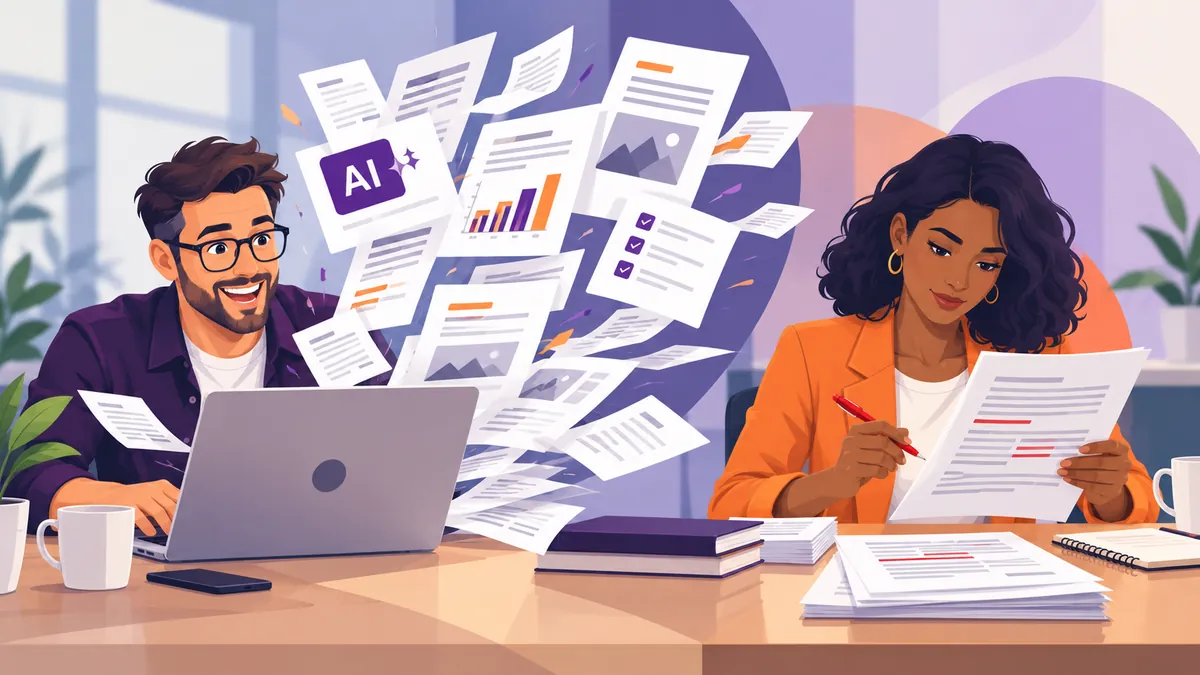
Part 4 of 6 in a series on AI, human capability and the future of work. Previously: AI Literacy Is More Than Knowing How to Prompt Next: From AI Adoption to AI Enablement
Why human oversight, verification and accountability matter when AI becomes part of everyday business decisions.
AI is becoming part of everyday business operations.
It's drafting customer communications, analysing financial information, preparing reports, recommending actions and helping employees make decisions.
In many cases, it's doing this faster than people could achieve independently.
That's a genuine productivity opportunity.
But as organisations become more comfortable using AI, there's a question I think business leaders need to ask more often.
Who is actually checking the work?
Not simply whether the document looks professional, the numbers appear reasonable or the recommendation sounds convincing.
Who's checking that the information is accurate, the assumptions are justified and the proposed actions are appropriate?
And perhaps more importantly, who is accountable when something goes wrong?
The problem with convincing answers
One of AI's greatest strengths is its ability to communicate clearly and confidently.
It can take a complicated subject and produce a well-structured explanation, complete with recommendations, supporting arguments and an apparently logical conclusion.
That's useful.
But confidence isn't evidence of accuracy.
AI systems can make factual errors, misinterpret information, overlook important context or generate plausible claims without sufficient supporting evidence.
Sometimes those problems are obvious.
More often, the challenge is that an answer can be largely correct while containing one significant error or omission.
Consider an AI-generated report that accurately summarises most of a company's sales performance but misinterprets an important trend.
The report might look credible, and the conclusions may seem reasonable.
But if that misunderstanding influences investment, recruitment or commercial decisions, the consequences could be significant.
The risk isn't simply that AI occasionally gets things wrong.
It's that people may become less inclined to question something that looks right.
Human in the loop. But what does that actually mean?
The phrase human in the loop is increasingly used when discussing responsible AI adoption.
The principle is straightforward: a person remains involved in reviewing or approving AI-generated work.
But there's a difference between having a human involved and having meaningful human oversight.
Imagine an employee receives an AI-generated analysis and is asked to approve it.
They scan the document, see that it's professionally presented and broadly consistent with their expectations, and click approve.
Technically, a human has reviewed the output.
But has anything meaningful been checked?
Did they understand the underlying data?
Were they qualified to evaluate the recommendations?
Did they have enough time to investigate potential weaknesses?
And were they empowered to challenge the result?
Human oversight only works when the person reviewing the output has the knowledge, time and authority to exercise judgment.
Otherwise, approval risks becoming another administrative task.
Not every AI output needs the same level of scrutiny
There's also a danger of making AI governance unnecessarily complicated.
Not every AI-generated response requires extensive verification.
If you're using AI to brainstorm meeting titles, improve the wording of an internal email or suggest alternative headlines, the risks are generally limited.
But using AI to interpret financial information, recommend employment decisions or produce advice that could affect customers is a different matter.
The level of oversight should reflect the potential consequences.
I think businesses can approach this through three practical levels.
Low-risk work: Review for usefulness
Examples include brainstorming, initial drafts, meeting agendas and routine internal content.
The person using AI checks that the output is relevant, appropriate and fit for purpose.
There's usually no need for a formal approval process.
Medium-risk work: Verify before use
Examples include customer-facing marketing claims, business analysis, commercial proposals and operational recommendations.
Here, employees should check important facts, assumptions, calculations and supporting evidence.
Where necessary, a colleague with relevant expertise should review the work before it's used.
High-risk work: Require specialist oversight
Examples include decisions affecting employment, safety, legal obligations, significant financial commitments or sensitive personal information.
These situations may require qualified specialists, documented checks, clear approval responsibilities and additional safeguards.
In some cases, AI may be unsuitable for the proposed task altogether.
These categories are a useful starting point rather than a substitute for a proper risk assessment.
The principle is simple.
The greater the potential impact, the stronger the oversight should be.
Verification is more than asking AI if it's correct
One mistake I see people making is asking an AI system to check its own work and treating the response as independent verification.
AI can certainly help identify inconsistencies, challenge reasoning and suggest areas that need investigation.
But asking the same system whether its previous answer was accurate doesn't guarantee that the answer has been properly verified.
It may repeat the original mistake or introduce a different one.
For important work, verification needs to go beyond the AI-generated response.
That might involve checking figures against source data, confirming claims using authoritative references, reviewing calculations or seeking advice from someone with relevant expertise.
It also means understanding where information came from.
Was the recommendation based on current business data, a supplied document, a reliable external source or an assumption generated by the model?
Those distinctions matter.
And they become particularly important when AI-generated content is passed between colleagues or incorporated into larger reports.
Once information has been copied into a professional-looking document, its original source and limitations can become surprisingly difficult to identify.
Google Search offers a useful example
In my own world of marketing, Google's guidance on AI-generated content provides a practical example of why human oversight matters.
Google isn't opposed to AI-generated content. But it expects content to be accurate, useful, original and created primarily for people rather than search engines.
Producing large volumes of generic content without adding genuine value can breach its spam policies, potentially affecting a website's visibility.
Google also places considerable emphasis on E-E-A-T: Experience, Expertise, Authoritativeness and Trustworthiness.
These are concepts Google uses when discussing how its systems assess helpful, reliable content, rather than a single ranking score.
This is where human contribution becomes particularly valuable.
AI can research a topic, structure an article and produce a convincing first draft. But what makes that article worth reading?
Often, it's the experience behind it. The practical examples, informed opinions, lessons learned and insights that come from actually doing the work.
That's what I try to bring to my own content.
I use AI extensively, but I also challenge its recommendations, check important claims and contribute my own experience and perspective.
The objective isn't simply to publish more content. It's to publish something genuinely worth reading.
And that's a useful principle for AI-generated work across any business, not just marketing.
The danger of automated assumptions
Let's consider another practical business example.
A company uses AI to analyse customer enquiries and recommend where its sales team should focus its efforts.
The AI identifies a particular sector as a promising opportunity based on enquiry volumes and apparent conversion rates.
The recommendation looks sensible.
But what if the underlying data is incomplete?
Perhaps the CRM doesn't consistently record why opportunities were lost.
Maybe some of the highest-value customers take much longer to convert.
Or perhaps the recommended sector generates plenty of enquiries but relatively poor margins.
Without that context, the analysis could encourage the business to pursue the wrong opportunities.
The AI hasn't necessarily failed to process the information it received.
The problem is that the available information doesn't tell the complete story.
This is why oversight must include questioning the quality and completeness of the information going into AI, not simply reviewing what comes out.
A well-presented recommendation built on incomplete information is still a risky recommendation.
Accountability doesn't transfer to the technology
As AI becomes more capable, it's tempting to treat its recommendations as if they carry their own authority.
But AI doesn't take responsibility for the commercial consequences of a decision.
People and organisations do.
If an AI-generated marketing claim is misleading, the business publishing it remains responsible.
If a financial recommendation is based on incorrect assumptions, someone still needs to understand and approve the decision.
And if an automated process creates problems for customers, the organisation must be able to explain what happened and put things right.
This doesn't mean every AI-assisted decision needs senior management approval.
That would quickly undermine many of the productivity benefits.
It means businesses need clarity about who owns the work, who checks it and who has authority to act.
In practical terms, employees should know when they can use AI independently, when verification is required and when something needs to be escalated.
Clear responsibilities help people use AI confidently rather than making them fearful of doing something wrong.
Give people permission to challenge the output
There's a cultural dimension to this that I think is easily overlooked.
If employees are under pressure to produce more work in less time, thorough checking can start to feel like an obstacle.
AI produces something quickly. The next task is waiting. The temptation is to accept the result and move on.
But meaningful oversight requires an environment where people are encouraged to ask questions.
They need permission to say the information is incomplete, the recommendation doesn't make sense or further investigation is needed.
And they need enough time to act on those concerns.
This is particularly important for less experienced employees who may lack confidence when challenging something that appears authoritative.
Good mentoring and supportive leadership can make an enormous difference.
An experienced colleague can explain what to look for, why a particular assumption matters and how to recognise potential problems.
Over time, that helps people develop their own judgment.
Checking AI shouldn't be treated as a failure of the technology. It should be a normal part of using it responsibly.
Building practical oversight into everyday work
For most SMEs, effective AI oversight doesn't need to begin with complicated governance systems.
It starts with a few straightforward questions.
What are we using AI for, and what could go wrong?What information is it using, and can we trust that information?Who is responsible for reviewing the output?What needs to be checked before the work is used?When should a decision be escalated to someone with greater expertise?How will we recognise and correct mistakes?
For recurring activities, these expectations can be built into existing processes.
A marketing team might introduce a simple checklist for AI-assisted content before publication.
A finance team might require calculations and source figures to be independently checked.
An operations team might define which recommendations can be implemented routinely and which require management approval.
The aim isn't to introduce bureaucracy for its own sake.
It's to create proportionate safeguards that support confident, effective use.
As organisations introduce more sophisticated AI agents and automated workflows, these principles become even more important.
When AI moves beyond generating recommendations and starts taking actions, businesses need to consider permissions, monitoring, approval points and how to stop or reverse an incorrect action.
Human oversight should be designed into the process, not added as an afterthought.
Trust AI enough to use it. Question it enough to use it well.
I believe AI can help businesses make better decisions, improve productivity and unlock capabilities that were previously difficult or expensive to access.
But those benefits depend on how thoughtfully we implement it.
We shouldn't expect people to question every sentence or distrust every recommendation.
Equally, we shouldn't encourage employees to accept AI-generated work simply because it looks credible.
The goal is informed confidence.
People who understand the tools, recognise their limitations and know when further scrutiny is needed.
Processes that make responsibility clear without creating unnecessary barriers.
And leaders who recognise that human judgment remains an essential part of effective AI adoption.
The question isn't whether a human has approved the AI's work. It's whether someone has genuinely understood and evaluated what they're approving.
As AI becomes more deeply embedded in your business, that's a distinction worth paying attention to.
So, who is checking the AI in your organisation?
And are they equipped to recognise when something isn't right?
References
Google Search Central — Guidance on using generative AI contentGoogle Search Central — Creating helpful, reliable, people-first contentGoogle Search Central — Spam policies for Google Web Search
FAQs
What does human in the loop actually mean?
It means a person reviews or approves AI-generated work before it is used. It only adds value when that person has the knowledge, time and authority to question the output, rather than simply clicking approve on something that looks professional.
Does every AI output need checking?
No. Oversight should match the risk. Brainstorms and internal drafts only need a quick check for usefulness, business analysis and customer-facing claims should be verified before use, and decisions affecting people, safety, money or legal obligations need specialist oversight.
Can I ask the AI to check its own work?
It can help spot inconsistencies, but it is not independent verification. For important work, check figures against source data, confirm claims with authoritative references and ask someone with relevant expertise to review it.
Who is accountable when AI gets something wrong?
The business, not the technology. Human oversight of AI works best when everyone knows who owns the work, who checks it and who has authority to act, so responsibility is clear without every decision needing senior approval.
Where should an SME start with AI oversight?
Ask a few practical questions: what you use AI for and what could go wrong, what information it relies on, who reviews the output, what must be checked and when to escalate. Then build those checks into existing processes.
This article was written by Peter Lowe. The ideas and opinions are his own; AI was used to assist with drafting and editing.