Why AI Projects Fail — Four Foundations That Stick
· By Peter Lowe
Category: Readiness
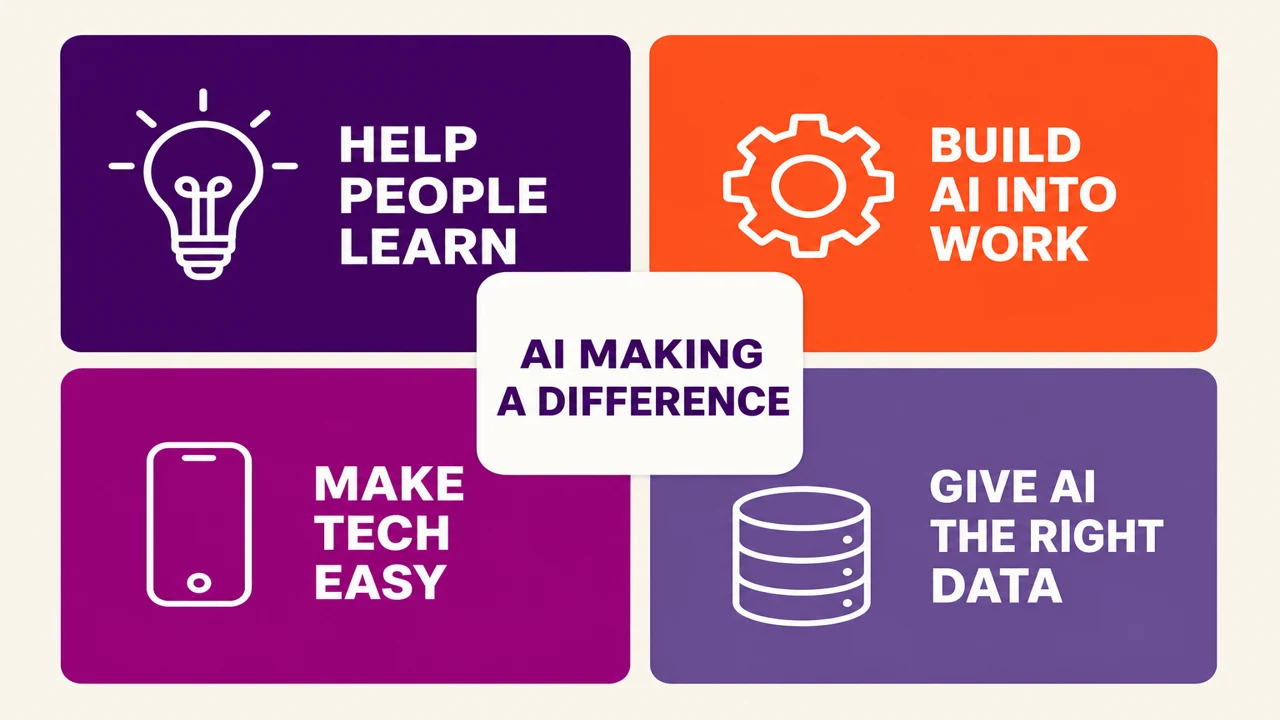
I came across a brilliant Venn diagram from [Clare Kitching](https://www.linkedin.com/in/clarekitching/) recently — four overlapping circles laying out what successful AI adoption actually requires. It stopped me scrolling because it said, in one image, what I spend most of my consulting calls trying to explain: the technology is almost never the problem.
I've watched enough SMEs run aground on AI projects to know the pattern. They buy the tool. They run a pilot. They see a flicker of magic. And then six months later it's quietly abandoned, the licence still ticking over on someone's credit card, and the team has gone back to doing things the old way.
It almost never fails because the AI doesn't work. It fails because one of these four foundations was missing — and, just as often, because nobody asked the question that should come before all four. That, in a nutshell, is why most AI projects fail.
## Start with the problem, not the tool
Most SMEs I meet are stuck at what I'd call the Copilot-chat stage. Everyone's got a licence, a few people use it to tidy up emails or ask the odd question, and that's where it stops. It's not nothing — but it's a long way from AI earning its keep.
What moves a business past that stage is a problem worth solving, named out loud. If you can't say what outcome you're after, two things go wrong. You can't tell whether the AI actually worked, because there was never a target to hit. And your team has no reason to change how they work, because nobody's told them what's in it for them. "Have a go with AI" earns you polite nodding. "We're going to get a quote out in two hours instead of two days" earns you engagement.
So before you spend a penny on tools or training, get specific about the problem. Everything that follows gets easier once you have — and the four foundations are what turn the answer into something real.
## Foundation 1: help people learn how to use AI
The single biggest predictor of whether AI adoption succeeds in a small business isn't the tool you choose. It's whether your team feels safe enough to play with it.
I've sat in offices where the boss has bought ChatGPT licences for the whole team, sent a one-line email saying "have a go," and then wondered six weeks later why nothing's changed. People weren't being lazy. They were being sensible. Nobody wants to be the first one to put a half-baked AI draft in front of a client and look like an idiot.
What works instead:
- **Celebrate the small wins out loud.** When someone uses AI to save 20 minutes on a task, make a fuss about it in the team meeting. That signal does more than any training course.
- **Let people experiment safely.** Give them low-stakes use cases first — drafting internal memos, summarising long emails, brainstorming. Not the customer-facing stuff where mistakes cost money.
- **Show practical examples people actually recognise.** Not "here's how a Fortune 500 uses AI." Try "here's how Sarah in accounts cut her month-end reporting by an hour."
The mistake almost everyone makes: treating AI training as a technical problem when it's a psychological one.
## Foundation 2: build AI into how work actually gets done
This is where most pilots die. The tool works in the demo. Then everyone goes back to their normal workflow, and the AI sits in a separate browser tab that nobody opens.
The fix is unglamorous: you have to redesign the work itself.
That means looking at your existing processes and asking, honestly, where does this take longer than it should? Then redesigning the workflow with AI in the loop, not bolted on the side. And critically, removing the manual steps that the AI now makes redundant — because if you don't, you've just added a layer instead of replacing one.
I worked with a client recently where we mapped out their entire content production workflow before we touched a single AI tool. We found three steps that no longer needed to exist. Removing those was worth more than any prompt we wrote afterwards.
The question isn't "where can we add AI?" It's "where is the work currently slow, and what would the workflow look like if we redesigned it from scratch knowing AI exists?"
> **Worth pausing here.** Foundations 1 and 2 are the hardest part of AI adoption — and they're also exactly what we cover in the Smart AI Studio [AI Essentials Workshop](/workshops). Half a day, up to 12 people from your team, £147 per person. We don't just teach the tools; we walk out with one workflow redesigned and one quick win in the bag. If you've already bought the licences and nothing's happening, this is usually the missing piece.
## Foundation 3: make the technology easy to use
If your team has to log into three separate tools, copy-paste between them, and remember a special prompt template just to get the AI to behave, they won't use it. Friction kills adoption faster than anything else.
This is where the right choice of tool matters — but not in the way most people think. The "best" AI tool isn't the one with the most features. It's the one your team will actually open on a Tuesday morning when they're busy.
Three things to look for:
- **Right tools for the job.** Don't try to make one AI tool do everything. A general assistant like Claude or ChatGPT for writing and thinking. A purpose-built tool for things like meeting transcription or image generation. Horses for courses.
- **Integration with what already exists.** If it doesn't talk to your CRM, your email, your document store, it's a tab people will forget. The biggest wins come from AI that lives inside the tools your team already uses.
- **Remove unnecessary friction.** Every extra click, every login, every "where did I save that prompt again" moment is a tax on adoption. Pay attention to the micro-frustrations.
The test I use: if the busiest person on your team had to use this tool right now with no help, would they? If the answer is "probably not," fix the friction before you do anything else.
## Foundation 4: give AI the right data
This is the foundation almost no SME wants to hear about, because it's the least sexy.
AI is only as good as what you feed it. A general-purpose model can write a passable blog post about anything, but it can't write your blog post — the one that sounds like you, references your case studies, knows your pricing, and reflects your point of view — unless you give it the raw material.
For most SMEs this means three jobs of work:
- **Connect AI to trusted data sources.** Your knowledge base, your past proposals, your brand guidelines, your customer data. The stuff that makes your business yours.
- **Organise your knowledge so AI can actually find it.** If your SOPs are scattered across seven SharePoint folders, three Google Drives, and someone's hard drive, you have a data project before you have an AI project.
- **Improve data quality and visibility.** Garbage in, garbage out. If your CRM is half-empty and your customer notes are stored in someone's head, no AI is going to fix that for you.
This is the foundation I find SME owners most likely to skip, and the one that, if you nail it, gives you a moat no off-the-shelf AI tool can replicate. Your data is your unfair advantage. Most of your competitors are too lazy to organise theirs.
## The bit in the middle
What I love about Clare's diagram is that the centre — "we see AI making a difference" — only happens when all four foundations overlap. It's not enough to have one or two. Strong training and weak data gets you confident people producing nonsense. Great data and bad workflows gets you a tool nobody opens. Easy tech and no learning culture gets you shelfware.
The businesses where AI actually changes the P&L are the ones that build all four foundations in parallel — and most of them do it in small, deliberate steps over six to twelve months, not in a big-bang transformation programme.
## The honest bit
If you're an SME owner reading this and thinking "we don't have any of these foundations in place" — you're not behind. You're normal. The vast majority of small and medium businesses are exactly here right now, somewhere between "we should do something about AI" and "we tried it and it didn't stick."
The good news is that none of these four foundations require a massive budget or a transformation team. They require a clear plan, a willingness to change how work gets done, and someone to keep you honest about which foundation needs attention next.
Name the problem. Pick the weakest of the four foundations. Fix it. Then move on. That's the whole methodology.
## Frequently asked questions
### Why do most AI projects fail in small businesses?
Rarely because the technology doesn't work. They fail when one of the four foundations — learning, workflow, easy tech, or good data — is missing, or because nobody named the actual problem the AI was meant to solve before buying the tool.
### Where should an SME start with AI adoption?
Start with a specific problem worth solving, stated as an outcome ("get a quote out in two hours instead of two days"). Then tackle the weakest of the four foundations first rather than trying to fix everything at once.
### How long does AI adoption take?
For most SMEs, six to twelve months of small, deliberate steps — not a big-bang transformation. Building the four foundations in parallel is what makes AI actually stick.
If you'd like to talk through which of the four foundations your business needs to work on first, [get in touch](/contact). The first conversation is always free, and I'll tell you honestly if AI isn't the right answer.
*With thanks to [Clare Kitching](https://www.linkedin.com/in/clarekitching/), whose original Venn diagram inspired this piece — follow her on LinkedIn for more on unlocking value from AI and data.*
This article was written by Peter Lowe. The ideas and opinions are his own; AI was used to assist with drafting and editing.