AI Literacy in Schools: Why the Ostrich Method Must End
· By Peter Lowe
Category: Readiness
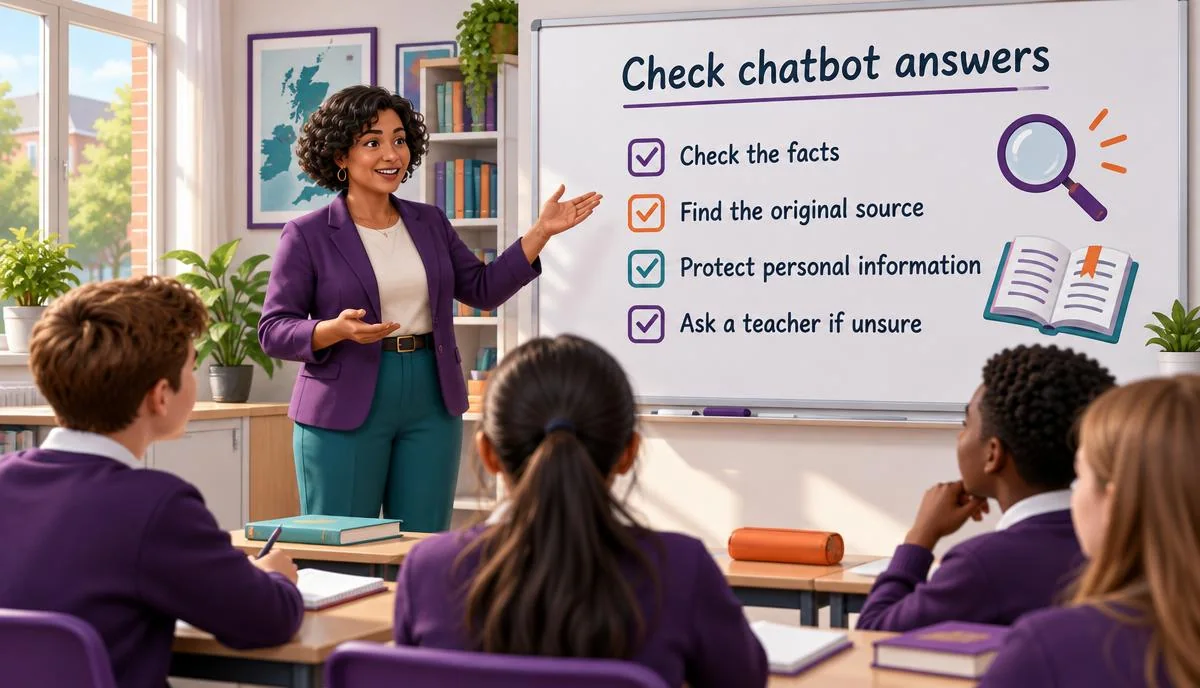
Schools do not need to agree that AI is a good thing before they teach young people how to understand it.
They need to recognise that a pupil who can open a chatbot is not necessarily equipped to judge its answers, protect their information or recognise when using it undermines their learning.
That is why the introduction of a dedicated AI literacy teacher at a school near Glasgow deserves attention. It gives this responsibility a named owner.
At Smart AI Studio, I advocate understanding the technology, identifying where it helps and putting clear boundaries around its use. Schools need the same practical approach.
## A dedicated teacher for AI literacy
BBC journalists Lucy Adams and Katy McCloskey report that Mearns Castle High School in East Renfrewshire has appointed Jamie Laycock, previously a principal teacher of biology, as its principal teacher of AI literacy.
The BBC describes the school as believed to be the first in the UK to make this dedicated appointment. The role focuses on helping pupils and staff understand AI's benefits and risks. [1]
To me, the important word is literacy.
Knowing which button to press is a small part of understanding a technology. AI literacy should include questioning an answer, recognising its limitations and deciding whether using the tool is appropriate.
A dedicated teacher can help build that understanding across subjects. But the responsibility should extend across the school, with support from leadership, safeguarding colleagues and subject teachers.
## Schools need practical guidance and support
In a separate BBC report, education reporter Hayley Clarke covers warnings that schools are "crying out" for government guidance.
The report she discusses, co-authored by Sir Anthony Seldon and Tim Bunting, calls for a national framework for AI adoption in education in England, including teacher training and school AI strategies. These are recommendations, rather than requirements already imposed on every school. [2]
It would be inaccurate to say guidance does not exist. England's Department for Education has published free training materials, developed by the Chiltern Learning Trust and Chartered College of Teaching, covering AI understanding, interaction, safety and use cases. Scotland also has resources, including Professor Judy Robertson's Teach AI Literacy: A Guide for Teachers. [3][4]
The practical challenge is turning resources into consistent classroom practice.
Teachers need time to learn, opportunities to ask questions and clear decisions about acceptable use. Asking them to work everything out individually risks leaving pupils with conflicting messages.
That is a leadership and support challenge.
## Why the Ostrich Method has run its course
I call avoiding the issue the "Ostrich Method": burying our heads in the sand and hoping AI will go away.
A school can restrict particular tools while still teaching pupils about AI. In fact, restrictions make more sense when pupils understand the reasons behind them.
My concern is that silence leaves those reasons unexplained. It leaves families trying to interpret a fast-changing technology without a shared framework.
This is not a criticism of teachers who are cautious. Caution is reasonable. Schools have limited resources and a responsibility to protect children.
But caution should lead to education, scrutiny and clear boundaries. It should not become indefinite avoidance.
Whether someone supports AI, dislikes it or remains undecided, understanding how it works is a sensible first step.
## A chatbot answer needs a different kind of scrutiny
A young person used to typing questions into Google may carry the same habit into OpenAI's ChatGPT, Anthropic's Claude, Google Gemini or Microsoft Copilot.
Type a question. Get an answer. Move on.
The danger is treating the generated response as an authoritative explanation.
Large language models generate text using learned patterns and probabilities. As Dave Chismon and Paul J explain for the National Cyber Security Centre, their underlying models use relationships between words to produce responses. They can also generate incorrect facts and biased content. [5]
This does not mean every answer is wrong. It means fluent language is not proof of accuracy.
Traditional search also requires judgement, and AI tools may retrieve information from the web. But retrieving a source and generating an answer are different processes. Pupils need to understand that distinction.
A useful classroom question is: "What evidence would help us decide whether this answer is correct?"
That question shifts attention from how convincing the response sounds to whether its claims stand up to scrutiny.
## The benefits deserve serious consideration
AI could help teachers prepare resources, develop revision activities and reduce administrative work. The Department for Education identifies these opportunities while noting that evidence on the benefits and risks of direct pupil use is still emerging. [6]
Schools should explore those possibilities with clear educational purposes and appropriate evaluation.
For example, a teacher might use AI to draft several practice questions, then check their accuracy and suitability. In an approved, supervised activity, pupils might compare explanations and identify which communicates a concept most clearly.
The measure of success should be what pupils understand afterwards.
Finishing a worksheet faster is not enough if the pupil cannot explain the reasoning. Equally, dismissing every use of AI may overlook ways it could support thoughtful teaching.
## What pupils should learn
UNESCO's AI competency framework for students includes ethics, a human-centred mindset, technical understanding and system design. It offers a broader starting point than teaching prompting alone. [7]
My practical starting point for schools would be five connected areas:
**Understand how answers are generated.** Explain learned patterns, probability and factual errors in language appropriate to pupils' ages. Use examples they can question without needing their own chatbot accounts.
**Check claims and sources.** Teach pupils to verify quotations, dates and references against credible original material. A reference printed in an answer should be investigated.
**Protect information and recognise harm.** Use classroom scenarios to discuss sensitive information, misleading content and harmful outputs. Pupils should know when to stop and speak to a trusted adult.
**Use AI within learning boundaries.** Explain which tasks allow assistance and which require independent work. Where use is permitted, ask pupils to describe what the tool contributed and what they checked.
**Know when to work without it.** Build opportunities to reason, write and solve problems independently. Pupils need to develop the knowledge that lets them evaluate assistance.
Teaching these areas does not require unrestricted access. England's DfE guidance explicitly emphasises age restrictions, safeguards and supervision for pupil use. [6]
## Teachers need support and pupils need fair access
AI literacy should not depend on attending a school with the resources to create a specialist post.
The Sutton Trust's July 2025 report Artificial Advantage?, by Kevin Latham and Rebecca Montacute, found that 45% of private-school teachers reported formal AI training, compared with 21% in state schools. It also reported clear school-wide staff AI strategies in 27% of private schools, compared with 9% of state schools. [8]
Those findings strengthen the case for shared training and support.
A dedicated appointment is one model. Schools could also share expertise through local authorities, trusts or partnerships, provided someone has clear responsibility and time to do the work.
Parents should be part of that conversation too. A school's expectations need to be understandable at home.
## Understanding comes before responsible use
Mearns Castle's appointment offers a useful prompt for school leaders: who is helping staff and pupils make sense of AI in our school?
The answer needs more substance than a ban, a subscription or an occasional assembly.
It needs supported teachers, clear expectations and regular opportunities for pupils to practise critical judgement.
AI has significant potential benefits and serious risks. Education should help young people understand both.
Whatever our personal opinion of AI, leaving pupils to discover its limitations by themselves is a poor starting point.
The time has come to put AI literacy firmly on the educational agenda.
## Sources and author acknowledgements
This article presents Peter Lowe's perspective for Smart AI Studio. Credit for the original reporting and research belongs to the authors and organisations below.
[1] Lucy Adams and Katy McCloskey, BBC News, Scotland's first AI teacher warns pupils: Don't trust everything it tells you. [Read the original source](https://www.bbc.co.uk/news/articles/c6qjk9n7gge7o)
[2] Hayley Clarke, BBC News, Schools not ready for AI and 'crying out' for government guidance, report warns, 22 September 2026. Reporting on proposals by Sir Anthony Seldon and Tim Bunting. [Read the original source](https://www.bbc.co.uk/news/articles/cw8r68mpm6p3o)
[3] Department for Education, with materials developed by the Chiltern Learning Trust and Chartered College of Teaching, Using AI in education settings: support materials, updated 19 May 2026. England-specific guidance. [Read the original source](https://www.gov.uk/government/collections/using-ai-in-education-settings-support-materials)
[4] Professor Judy Robertson, Teach AI Literacy: A Guide for Teachers, 21 May 2025, University of Edinburgh Research Explorer. [Read the original source](https://www.research.ed.ac.uk/en/publications/teach-ai-literacy-a-guide-for-teachers/)
[5] Dave Chismon and Paul J, National Cyber Security Centre, ChatGPT and large language models: what's the risk?, 14 March 2023. Cited for foundational explanation and limitations, rather than current product specifications. [Read the original source](https://www.ncsc.gov.uk/blog-post/chatgpt-and-large-language-models-whats-the-risk)
[6] Department for Education, Generative artificial intelligence (AI) in education. England-specific guidance. [Read the original source](https://www.gov.uk/government/publications/generative-artificial-intelligence-in-education/generative-artificial-intelligence-ai-in-education)
[7] UNESCO, AI competency framework for students, 2024. [Read the original source](https://www.unesco.org/en/articles/ai-competency-framework-students)
[8] Kevin Latham and Rebecca Montacute, Sutton Trust, Artificial Advantage? AI in the classroom and the inequality gap, July 2025. [Read the original source](https://www.suttontrust.com/wp-content/uploads/2025/07/Artificial-advantage.pdf)
## Further reading
For the wider leadership context, see [AI literacy for leaders](/insights/ai-literacy-leaders/) and [AI training versus AI enablement](/insights/ai-training-vs-ai-enablement/). If you would like to discuss practical AI literacy and clear boundaries in your organisation, [get in touch](/contact/).
## FAQs
### What should AI literacy in schools cover?
Pupils need to understand how chatbot answers are generated, check facts and original sources, protect personal information, recognise harmful outputs and know when to work independently. Prompting is only one part of that understanding.
### Does teaching AI literacy mean giving pupils unrestricted chatbot access?
No. Schools can teach AI literacy through age-appropriate examples and supervised activities without requiring pupils to have their own chatbot accounts. Tool use must follow applicable age restrictions, safeguarding arrangements and school learning boundaries.
### How can pupils check whether a chatbot answer is accurate?
Identify the claims in the answer, then compare them with credible original sources. Check quotations, dates and references rather than accepting a confident response as evidence. If an answer is unclear or concerning, ask a teacher or trusted adult.
This article was written by Peter Lowe. The ideas and opinions are his own; AI was used to assist with drafting and editing.