AI Can Produce the Work. But Do You Know If It's Any Good?
· By Peter Lowe
Category: Readiness
Part 2 of 6 in a series on AI, human capability and the future of work. Previously: Who Is Mentoring the Next Generation? Next: AI Literacy Is More Than Knowing How to Prompt
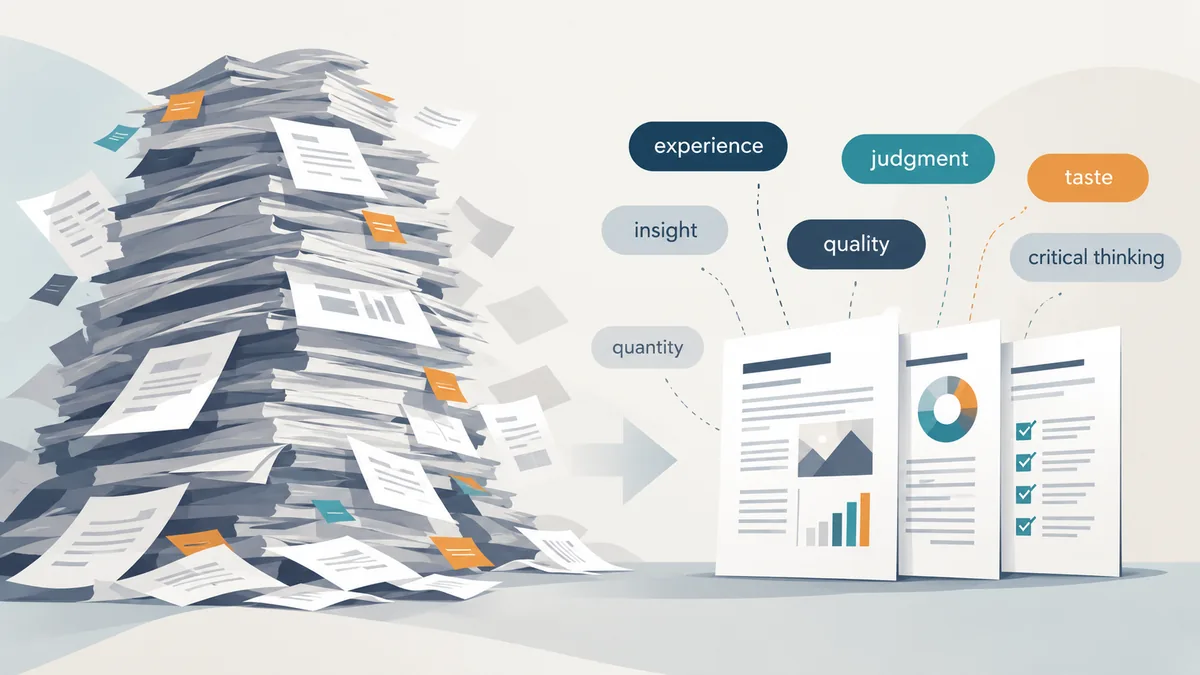
Why experience, critical thinking, judgment and taste matter when AI makes professional-looking work easier than ever.
AI has made it remarkably easy to produce work that looks professional.
Marketing strategies, business plans, campaign proposals, presentations and detailed reports can now be generated in minutes.
For busy professionals, particularly those managing multiple responsibilities, that's an enormous advantage.
But there's a problem we need to talk about.
Just because AI produces something that looks convincing doesn't mean it's right, relevant or effective.
And perhaps more importantly, if you don't have the experience or knowledge to evaluate what it's produced, how would you know?
The illusion of a good strategy
Imagine you're a marketing manager working for a medium-sized B2B business.
You're responsible for the website, social media, email marketing, advertising, content and increasingly the company's AI activities.
Your managing director asks for a marketing strategy to generate more enquiries.
You turn to AI.
Within minutes, you have a comprehensive document containing:
A SWOT analysis and market overview.
Target audience descriptions.
Content pillars and campaign themes.
SEO and social media recommendations.
A three-month activity plan.
Suggested KPIs and performance measures.
It's well written, logically structured and looks impressive.
You might even turn it into a polished presentation for the next management meeting.
But is it a good strategy?
That depends on something the document itself might not reveal.
Did anyone ask the right questions before creating it?
What does AI actually know about your business?
Before developing a marketing strategy, I'd want to understand the business.
Who are its most profitable customers? What problems do they need solving? Why do they choose this company over its competitors?
What triggers someone to start looking for a solution?
How long does the buying process take? Who influences the decision? What objections regularly prevent a sale?
Which services offer the best commercial opportunities? Where is the business genuinely differentiated?
And what does success look like beyond more website traffic, impressions or social media engagement?
These aren't minor details.
They're the foundations of an effective strategy.
If you haven't provided that context, AI will often fill the gaps with plausible assumptions, conventional recommendations and patterns drawn from its training.
The resulting strategy might be perfectly reasonable for a generic business in your industry.
But your business isn't generic.
Your customers, commercial priorities, capabilities and competitive position are specific to you.
Without that understanding, what looks like a strategy may simply be a well-organised collection of marketing activities.
AI can't know what your business doesn't share
Of course, this isn't a problem unique to AI.
In nearly 40 years of marketing, I've rarely encountered a situation where everyone had complete information before developing a strategy.
Marketing needs insight from Sales, Finance, Commercial, Operations and Business Development to understand customers, profitability, capacity, opportunities and business priorities.
But those departments are busy. Information sits in different systems. People have competing priorities, and getting everyone into the same room can be almost impossible without direction from senior leadership.
So marketing teams often go into battle armed with incomplete information, a few educated guesses and assumptions they hope are correct.
Experienced marketers recognise those gaps. They know which assumptions need challenging, where to seek further information and which decisions carry the greatest risk.
AI faces exactly the same problem. If incomplete organisational knowledge is all you give it, that's what it has to work with.
It may help identify gaps, ask better questions and test assumptions. But it cannot reliably reconstruct business knowledge that hasn't been shared.
And if those assumptions aren't made explicit, the resulting strategy can look far more certain than the evidence justifies.
This is why effective AI adoption isn't simply about better prompting. It's also about better information sharing, cross-functional collaboration and organisational clarity.
You can't expect AI to understand your business better than your business understands itself.
AI can bridge a knowledge gap. It can also hide one.
This is one of my biggest concerns about how AI is being adopted.
AI can help someone work beyond their existing knowledge and experience. That's a genuinely exciting opportunity.
But it can also make gaps in their understanding much less visible.
Someone with limited strategic marketing experience might struggle to develop a comprehensive marketing plan independently.
With AI, they can produce one that looks credible in minutes.
The danger isn't necessarily that the information is factually wrong.
It's that the recommendations may be incomplete, poorly prioritised or based on assumptions that nobody has challenged.
A busy manager might see a professional-looking strategy and assume the strategic thinking has already happened.
But a convincing answer isn't evidence that the right problem has been understood.
And if nobody recognises what's missing, those weaknesses can flow through into campaign planning, budgets, content production and ultimately business performance.
What nearly 40 years in marketing has taught me
I've spent nearly four decades working across marketing and design, from creative execution through to strategic planning and leadership.
During that time, I've seen plenty of ideas that looked good on paper but didn't deliver the intended results.
I've also seen relatively simple ideas succeed because they were built on a clear understanding of the audience, the problem and the desired outcome.
Experience teaches you to look beyond the surface.
When reviewing an AI-generated marketing strategy, I don't just consider whether the recommendations sound sensible.
I question the assumptions behind them.
I look for missing information, weak differentiation, unrealistic expectations and activity that isn't clearly connected to commercial objectives.
I ask whether the recommendations reflect how customers actually make decisions.
Sometimes the most valuable contribution isn't improving the document.
It's recognising that we shouldn't be producing that document yet because we haven't properly understood the problem.
That ability develops through experience, reflection, feedback and learning from mistakes.
AI can support the process enormously.
But it doesn't remove the need for someone to exercise judgment.
The importance of taste
Taste is an interesting concept because people often associate it with aesthetics or personal preference.
In professional work, I think it's much broader.
Taste is the ability to recognise quality, relevance and appropriateness within a particular context.
In design, that might mean recognising when something is visually attractive but fails to communicate the intended message.
In marketing, it might mean recognising that a campaign is technically competent but lacks a compelling proposition.
In strategy, it might mean identifying an opportunity that others have overlooked, or recognising when an apparently sensible recommendation is unlikely to work.
Good taste isn't simply about liking something.
It's informed by knowledge, observation, experience and an understanding of what you're trying to achieve.
And importantly, it can be developed.
Through mentoring, constructive criticism, exposure to good work and the opportunity to understand why some approaches succeed while others fail.
As AI makes it easier for everyone to produce competent-looking work, I believe this ability to distinguish between adequate and genuinely effective work will become increasingly valuable.
More output doesn't necessarily mean better outcomes
One of the easiest traps to fall into with AI is measuring success through activity.
More blog posts. More social media content. More presentations. More reports.
All produced faster and at lower cost.
That can represent a genuine productivity improvement.
But only if the work contributes to something useful.
Publishing twice as much content that doesn't reach or influence the right audience isn't necessarily progress.
Neither is implementing a detailed marketing strategy that doesn't address the business's real commercial challenges.
We need to distinguish between three things:
Output: What have we produced?
Quality: Is the work accurate, relevant and appropriate?
Outcome: Has it achieved what we intended?
AI can dramatically improve our capacity to produce output.
But quality and outcomes still require context, evaluation, feedback and judgment.
And that's where human capability becomes so important.
From AI adoption to genuine AI enablement
I believe organisations need to think beyond giving employees access to AI tools.
AI literacy is important, but knowing how to write a prompt or use an AI assistant is only the beginning.
People also need to understand how to define problems, provide meaningful context, question assumptions and critically evaluate the responses they receive.
They need access to the knowledge that makes AI useful.
This is why I create a comprehensive Brand Playbook as the cornerstone of any marketing activity.
For me, a Brand Playbook goes well beyond logos, colours and tone of voice. It brings together the business's positioning, ideal customer profiles, audience pain points, buying triggers, value propositions, messaging, commercial objectives and the principles that guide marketing decisions.
Developing it requires conversations across the business, challenging assumptions and gathering the knowledge that might otherwise remain scattered between departments.
It creates a shared understanding of who we're trying to reach, what matters to them, why they should choose us and what we're trying to achieve.
That becomes the foundation for developing genuinely aligned marketing strategies, whether the work is produced by people, AI or a combination of both.
The Brand Playbook provides the context. Experience and judgment help interpret it. AI helps turn that understanding into action.
But documentation alone isn't enough.
Experienced professionals still need to help colleagues recognise weaknesses, understand commercial context and develop the confidence to challenge recommendations rather than simply accept them.
AI can become part of that learning process too, acting as a thinking partner, asking questions, testing assumptions and helping people explore alternatives.
The opportunity is to combine the strengths of both.
The future belongs to people who can think, not just produce
I'm enthusiastic about what AI makes possible.
It has transformed how I work, allowing me to explore ideas, analyse information, develop solutions and produce work more efficiently.
But my experience still matters.
It helps me understand what to ask, recognise what's missing, challenge recommendations and decide whether the output is fit for purpose.
That's the combination I believe businesses should be developing across their teams.
Not simply people who can operate AI tools, but people who can use them intelligently.
People who understand their objectives, question assumptions, recognise quality and make informed decisions.
Because as AI makes producing work easier, the ability to understand, evaluate and improve that work becomes more valuable, not less.
And that raises an important question for every business leader.
Are you simply helping your people produce more with AI, or are you developing their ability to recognise what good actually looks like?
FAQs
Why isn't a professional-looking AI strategy enough on its own?
Because a convincing document isn't evidence that the right questions were asked. Without your customers, margins and priorities, AI fills gaps with plausible assumptions, so the plan may suit a generic business rather than yours.
What does taste mean in professional work?
It is the ability to recognise quality, relevance and appropriateness in context. It goes beyond personal preference: it comes from knowledge, experience and understanding what the work needs to achieve, and it can be developed through mentoring and feedback.
How do I give AI the context it needs?
Gather the knowledge that usually sits across departments: ideal customers, buying triggers, value propositions, messaging and commercial objectives. A Brand Playbook brings this together so people and AI start from the same shared understanding.
How can a business build better judgment around AI?
Go beyond tool access and prompting. Teach people to define the problem, question assumptions and evaluate responses, and give experienced colleagues time to review AI-assisted work with others so the team learns what good looks like.
This article was written by Peter Lowe. The ideas and opinions are his own; AI was used to assist with drafting and editing.