From AI Adoption to AI Enablement
· By Peter Lowe
Category: Readiness
Part 5 of 6 in a series on AI, human capability and the future of work. Previously: Who Is Checking the AI? Next: The AI-Enabled Generalist: Superpower or Single Point of Failure?
Giving employees access to AI is relatively easy. Helping them use it effectively is a leadership responsibility.
There's a difference between adopting AI and enabling people to use it well.
A business might introduce Microsoft Copilot, provide access to ChatGPT or encourage employees to experiment with AI tools.
A few training sessions follow. People learn how to write prompts, summarise documents, draft emails and produce presentations.
Some employees embrace the technology immediately. Others are more cautious. A few become the unofficial AI experts that everyone turns to for help.
Six months later, the business might have plenty of AI activity but little understanding of what has actually improved.
Are people saving time?
Is the quality of work better?
Have processes become more efficient?
Are employees developing new capabilities?
Or are they simply producing more work, more quickly?
Giving people AI tools is adoption. Giving them the knowledge, support and opportunity to use those tools effectively is enablement.
And I think that distinction deserves much more attention.
Adoption is relatively straightforward. Enablement takes work.
It's understandable why businesses focus initially on technology.
Tools are tangible. Licences can be purchased, accounts created and training sessions arranged.
It's relatively easy to report that 50 employees now have access to an AI assistant.
But access tells us very little about the value being created.
Someone might use AI every day without significantly improving their work.
Another employee might use it twice a week to solve a particularly difficult problem and generate considerable value.
Usage isn't the same as effectiveness.
And effectiveness depends on more than individual enthusiasm.
Employees need to understand the problems they're trying to solve, have access to relevant information and know how their work contributes to wider business objectives.
They also need the confidence to experiment, the skills to evaluate results and the opportunity to learn from others.
None of that happens automatically when you purchase a software licence.
The problem with expecting people to work it out
I've seen plenty of new technologies introduced into businesses over the years.
There's often an initial burst of enthusiasm, followed by a familiar pattern.
A small number of people explore the technology and become proficient.
Others use the basic features they've been shown.
Some struggle to see how it relates to their responsibilities.
And eventually, the business moves on to the next priority.
AI risks following the same pattern, although the pace of change is considerably faster.
One of the challenges is that employees are already busy.
They're managing existing workloads, responding to customers, attending meetings and trying to meet deadlines.
Asking them to explore AI, identify opportunities and redesign their own working practices can become another responsibility added to an already full day.
The people who have the most to gain from AI may be the ones with the least time to investigate it.
And those who experiment successfully may not have the opportunity to share what they've learned.
If businesses want meaningful adoption, they need to create the conditions that make learning and improvement possible.
You can't expect employees to transform how they work without giving them the time and support to do it.
Start with the work, not the technology
My approach to AI has always been problems first, tools second.
Before deciding where AI fits, I want to understand how a business actually operates.
What are people trying to achieve?
Where are the delays, frustrations and repetitive activities?
Which processes depend on manual effort?
Where does information get lost, duplicated or misunderstood?
And what prevents employees from doing their best work?
Sometimes AI is part of the answer.
Sometimes the problem is an unclear process, inconsistent information, unnecessary approvals or a lack of communication between departments.
Adding AI to those problems doesn't necessarily solve them.
It may simply help the business produce the same confusion more quickly.
Take a company where employees spend hours preparing weekly management reports.
AI might help summarise the information and produce a polished report.
But if the underlying data is inconsistent, departments use different definitions and nobody agrees which measures matter, the business still has a problem.
The report might look better.
The decision-making might not improve at all.
This is why process understanding should come before automation.
You can't automate chaos and expect clarity.
AI needs access to business knowledge
One of the biggest barriers to effective AI use isn't the technology itself.
It's the information available to the people using it.
Businesses hold enormous amounts of valuable knowledge.
Some of it is documented in policies, procedures, reports and systems.
But much of it exists in people's heads.
Experienced employees understand why certain decisions were made, which customers need particular attention and where the exceptions to standard processes occur.
Different departments often hold different parts of the picture.
Sales understands customer objections and buying behaviour.
Finance understands margins, costs and commercial performance.
Operations understands delivery constraints and practical limitations.
Marketing understands positioning, messaging and audience engagement.
But how often is that knowledge brought together?
In my own marketing work, I've frequently found that the information needed to create an effective strategy is spread across several departments.
That's one reason I place so much emphasis on developing a comprehensive Brand Playbook.
It isn't simply a document about logos, colours and tone of voice.
It captures positioning, ideal customers, customer challenges, buying triggers, value propositions, commercial objectives and the principles that guide marketing decisions.
Developing it requires conversations, collaboration and a willingness to challenge assumptions.
Once that knowledge has been brought together, it becomes a valuable foundation for both people and AI.
Without it, employees may be asking AI to produce work based on incomplete information.
AI doesn't create business understanding. It needs access to it.
Managers have an important role to play
AI enablement isn't simply an IT responsibility.
Nor should it be left entirely to employees who happen to be enthusiastic about the technology.
Managers need to understand enough about AI to recognise opportunities, support their teams and make informed decisions.
They don't need to become technical experts.
But they should be able to ask useful questions.
What problem are we solving?
How does this fit into our existing process?
What information will the AI need?
What could go wrong?
How will we know whether it's working?
And what support will employees need?
Managers also have an important role in creating an environment where people feel comfortable experimenting.
Employees need to know that they're allowed to explore better ways of working, question existing processes and share what they've learned.
They also need clear boundaries around data protection, confidentiality, verification and approval.
Too much restriction can discourage useful experimentation.
Too little guidance can create unnecessary risks.
Good leadership finds a sensible balance.
Training should develop capability, not just familiarity
There's an important difference between showing someone what an AI tool can do and helping them become confident using it in their own work.
A demonstration might be impressive.
But if employees return to their desks without knowing how to apply what they've learned, much of the value can disappear.
I believe AI training works best when it's connected to real responsibilities and practical problems.
A marketing employee might explore how AI can support research, campaign planning and content development.
Someone in operations might investigate process documentation, reporting or identifying recurring problems.
A manager might use AI to challenge a proposal, prepare for a difficult conversation or explore alternative approaches to a business decision.
The underlying AI skills may be similar.
But the applications are different.
People also need opportunities to practise, receive feedback and build confidence.
And they need to understand when AI-generated work requires checking, further investigation or specialist review.
This connects directly with the wider issue of AI literacy.
Knowing how to prompt is useful.
Understanding how to apply AI, evaluate its output and take responsibility for decisions is considerably more valuable.
Don't overlook the people who already know the business
One concern I have about the current enthusiasm for AI is that businesses may undervalue the experience of existing employees.
Someone who has spent 20 years working in operations might not be particularly confident with new technology.
But they may understand the business's processes, customers and practical challenges better than almost anyone.
That knowledge is enormously valuable when identifying opportunities for AI.
Likewise, a younger employee may be comfortable experimenting with AI but lack the experience to recognise whether a recommendation is commercially sensible.
Bring those people together and you have an opportunity for both to learn.
The experienced employee contributes knowledge and judgment.
The AI-confident employee brings curiosity and familiarity with the technology.
Together, they can explore better ways of working.
This is also an opportunity to strengthen mentoring rather than allowing it to disappear.
AI enablement should help businesses develop the capabilities of their people, not simply extract more output from fewer employees.
Measure outcomes, not activity
One of the easiest mistakes businesses can make is measuring AI success through usage.
How many employees have accounts?
How many prompts are being submitted?
How many documents have been generated?
Those figures might tell us whether people are engaging with the technology.
But they don't necessarily tell us whether the business is benefiting.
I'd rather understand what has changed.
Has a repetitive task become quicker?
Have errors reduced?
Are customer enquiries being handled more effectively?
Can employees spend more time on higher-value work?
Are decisions being made with better information?
And are people developing skills that make them more capable?
Time saved is important, but it isn't the only measure.
If AI reduces a task from three hours to 30 minutes but the output requires another two hours of correction, the benefit is questionable.
Similarly, producing twice as much content doesn't necessarily mean generating twice as much business value.
The objective should be better outcomes, not simply greater output.
What practical AI enablement looks like
For most SMEs, I don't think this needs to become a large transformation programme.
A practical approach can begin with a few manageable steps.
Understand where you are today. Assess how employees currently use AI, their confidence levels, existing processes and the opportunities or risks they can identify.
Choose a small number of meaningful problems. Focus on activities where improvement would make a genuine difference rather than trying to introduce AI everywhere at once.
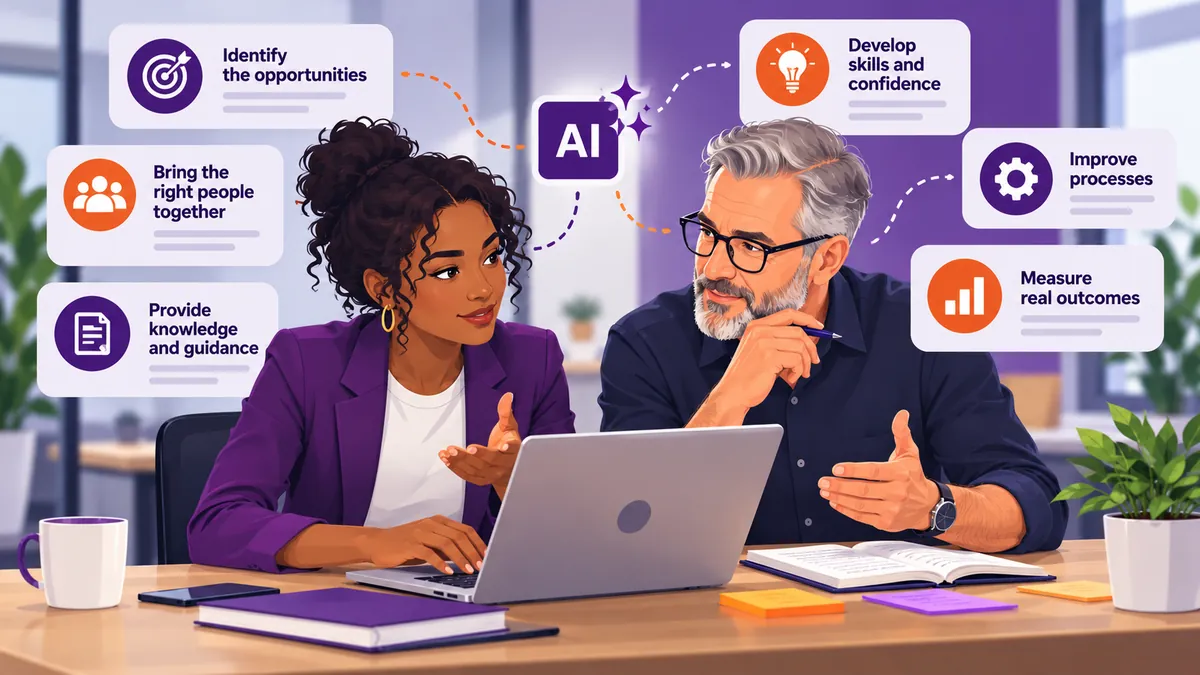
Bring the right people together. Include those who understand the process, those who use it every day and those responsible for the outcomes.
Provide relevant knowledge and guidance. Make sure employees have access to accurate information, clear objectives and sensible rules for using AI.
Develop skills through practical application. Give people opportunities to experiment, evaluate results, share learning and improve their approach.
Review what has changed. Measure the impact on time, quality, cost, customer experience and employee capability.
Then refine the approach and build on what works.
That may sound less exciting than announcing an ambitious AI transformation strategy.
But it's often a more realistic way for smaller businesses to achieve sustainable progress.
AI enablement is a leadership decision
The organisations that benefit most from AI won't necessarily be those that adopt the greatest number of tools.
I suspect they'll be the ones that understand their businesses, invest in their people and create the conditions for technology to be used effectively.
That requires leadership.
Not because senior managers need to understand every technical detail, but because they influence priorities, resources, culture and the way knowledge is shared.
If employees are expected to improve productivity without time to learn, access to information or permission to challenge existing practices, AI will struggle to deliver its potential.
If businesses focus only on reducing costs and increasing output, they may overlook opportunities to develop skills, improve decisions and strengthen their organisations.
AI can help people become more capable.
But that doesn't happen simply because the technology is available.
Adoption puts AI into people's hands. Enablement gives them the understanding, confidence and support to make something valuable happen with it.
And for business leaders, that's the distinction worth focusing on.
The question isn't simply whether your employees are using AI.
It's whether your business is helping them become better at what they do because of it.
FAQs
What is the difference between AI adoption and AI enablement?
Adoption gives people AI tools. AI enablement gives them the knowledge, time, support and opportunity to use those tools well in their own work, so the business sees better outcomes rather than just more activity.
Why do AI rollouts often stall after the first few months?
Employees are already busy, training stays generic and the people who experiment successfully rarely get the chance to share what they have learned. Without time and support, most people stick to the basic features they were shown.
Who is responsible for AI enablement in a business?
It is a leadership decision, not just an IT task. Managers shape priorities, resources and culture, so they need enough understanding to recognise opportunities, ask useful questions and give their teams permission to experiment sensibly.
How should we measure whether AI is working?
Measure outcomes, not activity. Rather than counting accounts or documents generated, look at whether tasks are quicker, quality is better, customers are served more effectively and employees are developing new capabilities.
Where should an SME start with AI enablement?
Understand how people use AI today, pick a small number of meaningful problems, bring together those who know the process, give them good knowledge and guidance, let them learn by doing, then review what has changed.
This article was written by Peter Lowe. The ideas and opinions are his own; AI was used to assist with drafting and editing.