The AI-Enabled Generalist: Superpower or Single Point of Failure?
· By Peter Lowe
Category: Readiness
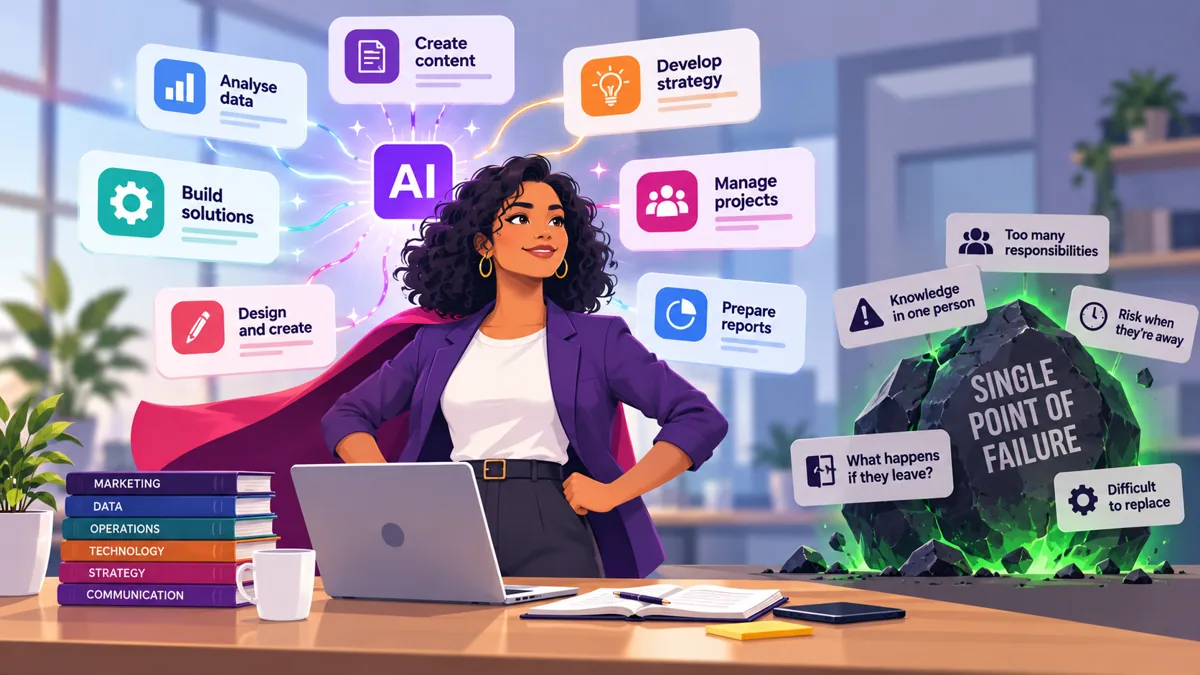
*Part 6 of 6 in a series on AI, human capability and the future of work. Previously: [From AI Adoption to AI Enablement](/insights/from-ai-adoption-to-ai-enablement/).*
*AI is helping employees work across more disciplines than ever before. But are businesses confusing broader capability with genuine expertise?*
There's a growing opportunity for businesses to do more with fewer resources.
AI can help a marketing manager analyse data, create content, build presentations and develop campaigns.
An operations manager can use it to document processes, investigate problems, prepare reports and explore automation.
A business owner can use AI to support activities that previously required several different specialists.
For SMEs, where budgets are limited and people already wear several hats, that's an exciting prospect.
I've experienced it myself.
AI has enabled me to explore technical solutions, build tools and work across areas that would previously have required considerably more external support.
But I've also spent enough time in business to recognise an important distinction.
**Being able to produce work across several disciplines doesn't automatically mean you have the expertise to make good decisions in all of them.**
And as businesses become more dependent on AI-enabled generalists, I think that's a distinction worth exploring.
## The rise of the AI-enabled generalist
Generalists have always played an important role in smaller businesses.
Someone who understands marketing, commercial operations, customer relationships and technology can be enormously valuable.
They connect different parts of the organisation, recognise opportunities and help get things done.
AI can make those people considerably more capable.
Tasks that once required specialist software, external support or significant time can now be approached with an AI assistant.
A capable generalist can research unfamiliar subjects, create first drafts, analyse information and test ideas far more quickly than before.
That's a genuine advantage.
But there's a danger that businesses begin to see AI as a substitute for the depth of knowledge that specialists bring.
If one employee can produce marketing content, analyse financial performance, develop software and prepare commercial proposals, why employ or engage several specialists?
It's an understandable question, particularly when businesses are under pressure to control costs.
But it assumes that producing the work and understanding the work are the same thing.
They aren't.
## Capability has expanded. Expertise still matters.
One of the most significant changes AI has brought to my own working life is the ability to move from an idea to a working solution much more quickly.
I can explore technical approaches, challenge assumptions, develop prototypes and investigate possibilities that would previously have taken considerably longer.
But I don't confuse that capability with being an experienced software engineer.
I can build something that works.
That doesn't automatically mean it's secure, maintainable, scalable or suitable for commercial deployment.
Those questions require a different level of expertise.
It's why I value having experienced technical specialists available to review work and identify issues that I might not recognise.
The same principle applies in other disciplines.
AI can help someone prepare financial analysis without making them an accountant.
It can help produce employment documentation without making someone an employment lawyer.
And it can generate a convincing marketing strategy without providing the commercial judgment developed through years of working with customers, budgets and changing markets.
None of this means generalists shouldn't use AI to extend their capabilities.
Quite the opposite.
**The opportunity is to expand what people can achieve while recognising where specialist expertise remains essential.**
## When one capable employee becomes the solution to everything
There's another risk that concerns me.
As businesses discover what an AI-enabled employee can accomplish, they may gradually increase that person's responsibilities.
The marketing manager becomes responsible for the website, CRM, reporting, automation, content production and perhaps even internal AI training.
The operations manager takes on process improvement, systems integration, data analysis and technology implementation.
Each additional responsibility seems reasonable.
After all, AI makes the work quicker.
But the combined effect can be very different.
The employee becomes the person everyone relies on.
They understand the systems, maintain the workflows, know how the AI tools are configured and hold much of the knowledge about how everything fits together.
They may become extraordinarily valuable to the business.
They may also become a significant organisational risk.
What happens when they're on holiday?
What happens when they leave?
Who understands the processes they've built?
Who can maintain the automations or recognise when something isn't working correctly?
And how much of that knowledge exists outside their own head?
**A highly capable employee can become a single point of failure if the business doesn't develop the systems and people around them.**
## The hidden cost of doing more
There's a tendency to measure AI productivity in terms of time saved.
If a task that previously took four hours now takes one, that's a substantial improvement.
But what happens to the three hours?
In some organisations, that time creates opportunities for better thinking, improved customer service, learning and innovation.
In others, it simply creates capacity for more work.
More responsibilities.
More projects.
More expectations.
And because AI makes individual tasks quicker, it can become harder to recognise when someone's overall workload has become unreasonable.
There's also a difference between the time required to produce something and the time needed to understand, verify and take responsibility for it.
AI might generate a report in minutes.
But evaluating the findings, checking the evidence and deciding what action to take still requires attention.
The more disciplines someone works across, the greater the demands on their judgment.
They may be moving between marketing, finance, technology and operational decisions throughout the day.
Each has different risks, priorities and standards.
AI can reduce the effort involved in producing work.
It doesn't eliminate the mental demands of making good decisions.
## What happens to the specialists?
I don't believe AI means every business needs to maintain the same roles and structures it had five years ago.
Technology changes how work is done, and businesses should be able to adapt.
But we should be careful about assuming that specialist expertise has become less valuable simply because AI can reproduce some of its visible outputs.
An experienced designer contributes more than the ability to produce an attractive image.
A skilled marketer brings an understanding of positioning, customers, commercial objectives and what makes a campaign effective.
An experienced developer considers security, reliability, maintainability and the consequences of technical decisions.
Much of that value is difficult to recognise when looking only at the finished work.
And it's often most apparent when something goes wrong.
The challenge for businesses is deciding which capabilities they genuinely need internally, which can be supported by AI and where external expertise remains important.
For many SMEs, that may mean using AI to strengthen a smaller internal team while maintaining relationships with trusted specialists.
Not every business needs a full-time expert in every discipline.
But every business needs access to appropriate expertise when the consequences justify it.
## The importance of knowing when to ask for help
I think one of the most valuable skills an AI-enabled generalist can develop is knowing the limits of their own understanding.
That isn't a weakness.
It's a professional strength.
AI makes it easier to investigate unfamiliar subjects, but it can also create a false sense of confidence.
You ask a question, receive a detailed explanation and successfully complete a task.
The next task is more complicated.
Then another.
Before long, you're working in an area where you may not fully appreciate the risks.
The problem isn't necessarily that AI has given you incorrect information.
It's that you don't know which questions you haven't asked.
Experience helps people recognise those gaps.
So does having access to knowledgeable colleagues, mentors and external specialists.
A capable generalist doesn't need to know everything.
They need to understand enough to identify problems, evaluate options and recognise when deeper expertise is required.
**The strongest generalists aren't the people who believe they can do everything. They're the people who know how to bring the right knowledge together.**
## Build capability without creating dependency
If businesses want to benefit from AI-enabled generalists, I think they need to consider how that capability is supported.
A few practical principles can make a significant difference.
### Document the knowledge
Important processes, decisions, workflows and system configurations shouldn't exist only in one person's head.
Documentation doesn't need to become a bureaucratic exercise.
It should simply make it possible for someone else to understand how things work and why particular decisions were made.
### Share responsibility
Where possible, avoid making one employee the only person who understands a critical system or process.
Give colleagues opportunities to learn, contribute and provide cover.
This also creates valuable opportunities for mentoring and professional development.
### Maintain access to specialist expertise
AI can help employees work across disciplines, but businesses still need appropriate expertise for decisions involving significant technical, financial, legal or operational risks.
That expertise might come from existing employees, external advisers or trusted delivery partners.
### Make time for learning
If someone is taking on new responsibilities with AI support, they need opportunities to develop the knowledge behind the work.
Otherwise, the business may be increasing dependency rather than building capability.
### Review the workload
Don't assume that faster individual tasks automatically mean an employee has unlimited capacity.
Consider the combined demands of their responsibilities, the complexity of their decisions and the time needed to check the quality of their work.
These aren't particularly complicated ideas.
But they can help businesses gain the benefits of AI without creating unnecessary vulnerabilities.
## Generalists and specialists should complement each other
I don't see the future as a choice between generalists and specialists.
I think AI creates an opportunity for them to work together more effectively.
A generalist with strong business understanding can use AI to explore ideas, prepare information and identify opportunities.
A specialist can bring deeper knowledge, challenge assumptions and help ensure that proposed solutions are appropriate.
AI can support both.
It can make specialist knowledge more accessible to generalists.
It can help specialists spend less time on routine production and more time applying their expertise.
And it can create opportunities for people to learn from one another.
The key is recognising that different forms of knowledge contribute different kinds of value.
Breadth helps people connect ideas and identify opportunities.
Depth helps them understand complexity, evaluate risk and make informed decisions.
**Businesses need both.**
## The opportunity is bigger than replacing roles
There's a wider question behind all of this.
What do we want AI to help our people become?
If the ambition is simply to reduce headcount and distribute more responsibilities among fewer employees, AI may deliver short-term savings.
But it could also create overstretched teams, concentrated knowledge and a growing dependence on individuals who are expected to understand too many disciplines.
If the ambition is to develop more capable people and more resilient organisations, the opportunities are considerably greater.
AI can help employees broaden their understanding, explore new skills and contribute beyond their traditional roles.
It can make smaller businesses more competitive and reduce some of the barriers that previously limited what they could achieve.
But those benefits depend on how we support people and how thoughtfully we design their responsibilities.
An AI-enabled generalist can be a tremendous asset.
They can also become a single point of failure if the organisation builds too much around them.
The difference comes down to leadership, knowledge sharing, realistic expectations and access to expertise.
And that brings me back to the question that started this series.
**As AI changes the work people do, are we also thinking carefully enough about the people we're developing for the future?**
Because the greatest opportunity isn't simply to help one person do the work of three.
It's to help people become more capable while building businesses that are stronger, more adaptable and less dependent on any one individual.
## Explore the series
- [Who Is Mentoring the Next Generation?](/insights/who-is-mentoring-the-next-generation/)
- [AI Can Produce the Work. But Do You Know If It's Any Good?](/insights/ai-can-produce-the-work-is-it-any-good/)
- [AI Literacy Is More Than Knowing How to Prompt](/insights/ai-literacy-more-than-prompting/)
- [Who Is Checking the AI?](/insights/who-is-checking-the-ai/)
- [From AI Adoption to AI Enablement](/insights/from-ai-adoption-to-ai-enablement/)
If your team needs help building capability without depending on one person, [Ongoing AI Support](/ai-consultancy/ongoing-support/) can help you support employees, identify opportunities and improve how your business works with AI.
## FAQs
### What is an AI-enabled generalist?
An AI-enabled generalist uses AI to work across several disciplines, such as marketing, operations, reporting and technology. AI broadens what they can produce, but it does not automatically give them the specialist expertise needed to judge every output or decision.
### Can AI-enabled generalists replace specialists?
They can take on some tasks that previously needed specialist support, but producing an output is not the same as understanding its risks. Technical, financial, legal and other consequential decisions still need appropriate expertise, whether that comes from colleagues or trusted external advisers.
### How can a business avoid creating a single point of failure?
Document important processes, decisions and system configurations, share responsibility and give colleagues opportunities to provide cover. Keep access to specialist expertise and make sure critical knowledge does not sit with only one employee.
### Does faster work mean someone can take on more responsibilities?
Not necessarily. AI can reduce production time, but checking the work, understanding unfamiliar subjects and taking responsibility for decisions still demand attention. Review the combined workload and leave time for learning rather than assuming every saving creates capacity for another task.
This article was written by Peter Lowe. The ideas and opinions are his own; AI was used to assist with drafting and editing.