AI Literacy Is More Than Knowing How to Prompt
· By Peter Lowe
Category: Readiness
Part 3 of 6 in a series on AI, human capability and the future of work. Previously: AI Can Produce the Work. But Do You Know If It's Any Good? Next: Who Is Checking the AI?
Why understanding, critical thinking and judgment matter as much as knowing how to use AI tools.
There's a growing emphasis on AI literacy in business.
Organisations are encouraging employees to experiment with ChatGPT, Microsoft Copilot, Gemini and other AI platforms. Training sessions introduce prompting techniques, demonstrate useful features and show people how to complete everyday tasks more efficiently.
That's a positive development.
But I think we're in danger of defining AI literacy too narrowly.
Knowing how to use an AI tool isn't the same as knowing how to use it well.
Someone can become proficient at prompting, generating documents, analysing information and creating content without necessarily understanding the limitations of what they're producing.
And that distinction matters.
Because the real value of AI isn't simply how quickly it can generate an answer. It's how effectively we use that answer to make decisions, solve problems and achieve meaningful outcomes.
Learning the tools is only the beginning
Think about someone attending their first AI training session.
They learn how to write a structured prompt, provide context, assign a role and specify the format of the response.
They discover how AI can summarise meetings, draft emails, analyse spreadsheets and create presentations.
Within a couple of hours, they're achieving things that previously took considerably longer.
That's valuable.
But what happens when the AI produces something that is incomplete, misleading or simply unsuitable for the task?
Can they recognise the problem?
Do they know which assumptions to challenge?
Can they distinguish between a confident explanation and a well-supported conclusion?
And do they understand when AI shouldn't be used at all?
These are just as important as knowing which buttons to press or how to structure a prompt.
AI literacy should develop our ability to think with AI, not simply instruct it.
Three levels of AI capability
I find it useful to think about AI literacy in three levels.
1. Knowing how to operate the tools
This is where most people begin.
Understanding what AI can do, how to structure prompts, upload relevant information and use different features.
It also means recognising basic limitations, including the possibility of inaccurate responses and the importance of protecting confidential information.
These are essential foundations.
But they don't automatically translate into effective business use.
2. Knowing how to apply AI in context
The next level is understanding how AI fits into your actual work.
What problem are you trying to solve?
What information does the AI need?
What constraints, objectives and business requirements should influence the response?
For example, asking AI to write a customer email is relatively straightforward.
Asking it to write an effective customer email requires an understanding of the customer, their circumstances, the relationship, the intended outcome and the organisation's tone of voice.
The difference is context.
And context depends on knowledge that may not exist within the AI system.
3. Knowing how to evaluate and improve the output
This is where critical thinking and professional judgment become particularly important.
Does the response make sense?
Is it accurate, relevant and supported by appropriate evidence?
What assumptions has AI made?
What's missing?
Would you be comfortable explaining or defending the recommendation to a colleague, customer or senior leader?
Someone who can ask these questions is developing a much more valuable capability than someone who simply knows how to generate a polished response.
And these three levels are not a one-way progression. People need to keep developing all of them as the technology and their responsibilities change.
AI can support thinking. It shouldn't replace it.
One of AI's greatest strengths is its ability to help us explore unfamiliar subjects.
We can ask questions, request explanations, compare alternatives and investigate ideas that might otherwise take hours of research.
This creates enormous opportunities for learning.
But there's an important distinction between using AI to develop understanding and using it to avoid having to understand something.
Imagine a junior employee asked to analyse why a business process is underperforming.
They could ask AI to review the available information and recommend improvements.
It might produce a sensible list of actions.
But if the employee simply copies those recommendations into a report, what have they learned?
Now imagine a different approach.
They ask AI to explain possible causes, identify missing information, challenge their assumptions and compare alternative solutions.
They investigate the suggestions, speak to colleagues who understand the process and consider the practical consequences.
They use AI to develop their thinking rather than bypass it.
The same technology is involved.
The difference is how it's being used.
AI should help people become better problem-solvers, not simply faster answer-producers.
Critical thinking is a skill we need to practise
Critical thinking isn't about being negative or questioning everything for the sake of it.
It's about approaching information with curiosity, recognising assumptions and evaluating whether conclusions are justified.
AI makes this especially important because it can communicate with remarkable confidence and fluency.
A response may be beautifully written, logically structured and entirely plausible.
That doesn't make it correct.
Nor does it mean the recommendation is appropriate for your particular circumstances.
We need to develop the habit of asking better questions.
What evidence supports this conclusion? What alternative explanations exist? What information is missing? What would change the recommendation?
And perhaps most importantly:
What do I need to understand before I can make a decision?
These are habits that can be developed through practice, feedback and experience.
AI can even help us practise them.
Ask it to challenge your reasoning, identify weaknesses in a proposal or argue the case for an alternative approach.
But remember that an AI-generated critique also needs evaluating. A convincing counterargument isn't necessarily a valid one.
The objective isn't to accept everything AI says or reject it automatically.
It's to develop the confidence and ability to make informed judgments.
Knowing what you don't know
One of the most valuable things experience teaches us is an awareness of our own limitations.
After nearly 40 years working in marketing and design, I'm comfortable recognising when something falls outside my expertise.
That doesn't mean I can't explore it with AI.
In fact, AI has made it much easier to investigate unfamiliar subjects, develop ideas and expand my capabilities.
But there's a difference between gaining enough understanding to ask informed questions and assuming I've become an expert.
That distinction can be harder for someone who hasn't yet developed a foundation in the subject.
If AI produces a credible-looking answer in an unfamiliar discipline, how do they recognise what's missing?
This is where learning from experienced colleagues remains so valuable.
A good mentor doesn't simply provide answers. They explain their reasoning, challenge assumptions and help someone understand the consequences of different decisions.
AI can complement that process, providing explanations, examples and opportunities to practise.
But we shouldn't confuse access to information with the development of expertise.
Better prompting starts before the prompt
There's another aspect of AI literacy that I think deserves more attention.
Before writing a prompt, we should understand what we're trying to achieve.
That sounds obvious, but it's surprisingly easy to begin with the tool rather than the problem.
Someone opens ChatGPT and asks it to create a marketing campaign, improve a process or write a business proposal.
But have they defined the objective?
Do they understand the audience, constraints and available information?
Have they considered what a successful outcome would look like?
If not, even a beautifully structured prompt may produce something that misses the mark.
This is why I encourage businesses to start with problems rather than tools.
The most effective AI users aren't necessarily those who know the most prompting techniques.
They're often the people who understand the problem, recognise what information is needed and can clearly describe the outcome they're trying to achieve.
The prompt is simply the means of communicating that understanding.
What should AI literacy training actually develop?
I believe effective AI literacy training should build confidence across several connected capabilities.
People should understand what AI can and cannot reliably do, including its limitations, potential biases and the risks associated with sensitive information.
They should learn to define problems, provide relevant context and communicate clear objectives.
They need practical experience evaluating outputs, checking important claims, identifying assumptions and recognising when human review or specialist expertise is required.
And they should develop the ability to use AI as a learning partner, not simply a production tool.
Importantly, this shouldn't become an academic exercise.
The best learning happens when people apply these skills to real tasks, receive feedback and gradually improve their judgment.
A marketing professional will need different practical examples from someone working in finance, operations or customer service.
But the underlying principles remain consistent.
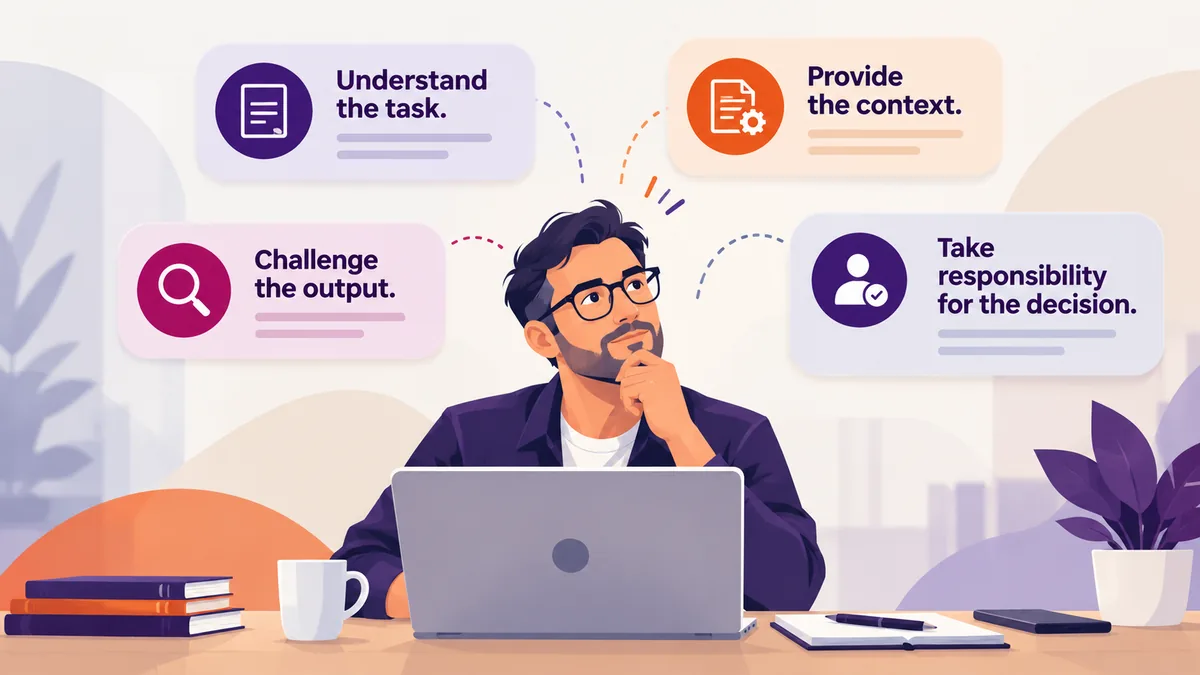
Understand the task. Provide the context. Challenge the output. Take responsibility for the decision.
That's a much stronger foundation for AI literacy than teaching people a collection of prompts they may never use again.
Building capability, not dependency
I believe AI offers one of the most significant opportunities for professional development we've seen in decades.
It can make knowledge more accessible, help people overcome barriers and give them opportunities to develop skills that might previously have been difficult to acquire.
But we need to be deliberate about how we use it.
If people become dependent on AI to complete tasks they don't understand, we risk creating a workforce that can produce increasingly sophisticated outputs without developing the knowledge and judgment needed to evaluate them.
If, instead, we use AI to encourage curiosity, strengthen critical thinking and accelerate learning, the possibilities are far more exciting.
This isn't about making everyone an expert in every discipline.
It's about helping people become more capable, confident and thoughtful in the work they do.
And recognising that human understanding remains essential, even as technology becomes more powerful.
The measure of successful AI literacy training shouldn't simply be what people can produce with AI. It should also be what they're learning to understand, question and do better because of it.
That's the difference between adopting AI and genuinely developing people.
FAQs
What is AI literacy?
It is more than knowing how to use AI tools. AI literacy means understanding what AI can and cannot reliably do, applying it in the context of your own work, and evaluating whether its output is accurate, relevant and fit for the decision in front of you.
Is learning to prompt enough?
Prompting is a useful foundation, but it is only the first level. People also need to define the problem, provide the right context and challenge the output. The best AI users often understand the problem best, not the most prompting techniques.
What are the three levels of AI capability?
Operating the tools, applying AI in the context of real work, and evaluating and improving what it produces. They are not a one-way progression: people need to keep developing all three as the technology and their responsibilities change.
How can AI support learning rather than replace thinking?
Use it to explain possible causes, identify missing information and challenge your assumptions, then check the suggestions with colleagues who know the work. Copying its recommendations straight into a report teaches you very little.
What should AI literacy training cover?
What AI can and cannot do, including risks with sensitive information; defining problems and giving context; checking outputs and knowing when specialist review is needed; and using AI as a learning partner. Practise on real tasks relevant to each role.
This article was written by Peter Lowe. The ideas and opinions are his own; AI was used to assist with drafting and editing.